People liked the post
Instagram: @thecolorprayer
A single dot can appear almost insignificant.
But when hundreds of dots are placed with patience, precision and intention, they can become something much larger—a rhythm, a pattern, a mandala.
For Vidushi Dhunta Narula, this repetitive process became more than an artistic technique. It became a way of slowing down, focusing inward and finding a sense of calm during a period of personal transition.
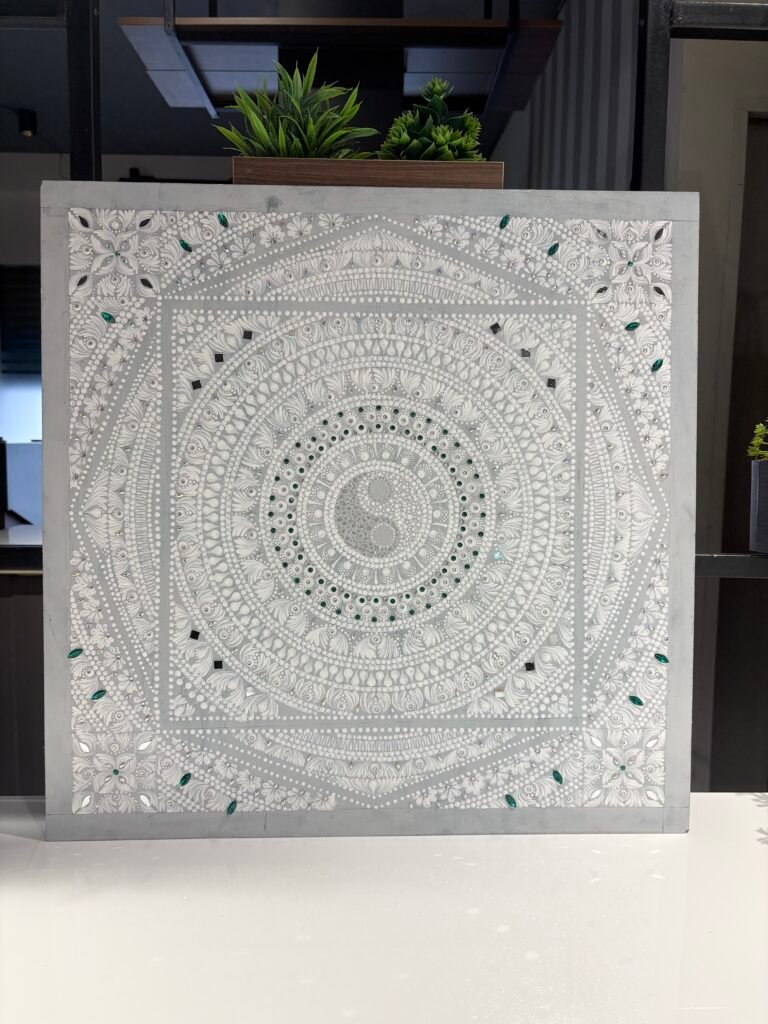
Today, the Gurugram-based artist works primarily with acrylic dot mandalas, creating intricate compositions on square canvases. Her practice brings together geometric precision and intuitive decision-making, allowing colour, pattern and rhythm to evolve organically across each work.
Her journey to this practice, however, began not in an art studio, but in the world of apparel design, merchandising and sourcing.
Born and raised in Dehradun, Vidushi Dhunta Narula grew up in a family where creativity was already part of everyday life.
Her father developed an interest in painting during the COVID-19 period, creating pencil sketches and oil paintings. He is also an avid collector of antiques and vintage cameras.
Her mother was a teacher, while one of her aunts works with three-dimensional painting. Other members of her family are connected with advertising.
Although Narula did not initially plan to become a professional artist, she grew up surrounded by people who valued creativity, making and visual expression.
That environment became one of the quieter influences on her own creative journey.
In 2011, Narula moved to Gurugram to pursue her education.
She studied apparel designing and merchandising at the Institute of Apparel Management and subsequently entered the corporate fashion and retail sector.
Her professional experience included working as a merchandiser for Williams-Sonoma, followed by sourcing responsibilities with Wildcraft.
Her work in merchandising and sourcing brought her close to materials, colour, textures and the practical side of design.
At the same time, she continued to draw privately.
After work, she often spent her evenings sketching and doodling rather than going out. Pens and pencils became a personal creative outlet, allowing her to experiment with lines and patterns without the pressure of creating finished artworks.
Looking back, those early sketches contained an important clue to the direction her art would eventually take.
Narula frequently created radial and geometric patterns while doodling.
At the time, they were simply a way to spend quiet evenings.
Later, when she discovered dot mandala art, she recognised something familiar in its concentric structures and repetitive patterns.
The transition therefore did not come completely out of nowhere. The visual language of mandalas had already been developing quietly through her everyday habit of drawing.
Around 2020, Narula returned to Dehradun during a period of personal transition.
Alongside navigating changes in her life, she completed a postgraduate course in yoga, adding another dimension to her interest in mindfulness and inner balance.
It was during this period that she encountered a dot mandala workshop.
Initially, she did not pay much attention to it. A cousin, however, encouraged her to attend.
The workshop lasted approximately three to four hours.
What happened during those hours changed the direction of her creative practice.
Dot mandala painting requires a very particular kind of attention.
One dot is placed.
Then another.
Then another.
The repetition demands patience and concentration.
For Narula, this process felt unexpectedly relaxing. The simple act of focusing on one point at a time gave her a way to become absorbed in the present moment.
What began as a workshop exercise gradually became a regular creative practice.
She began experimenting independently, moving beyond the techniques introduced in the workshop and developing her own compositions.
The experience also changed how she understood art.
For her, making mandalas was not only about creating visually detailed paintings. It was also about the state of mind that emerged while making them.
Narula’s initial connection with dot mandalas was deeply personal.
During a difficult period, the process offered her a sense of relaxation and grounding.
That experience eventually influenced the direction of her professional life.
A turning point came when she participated in a mall exhibition and sold an original dot painting.
The sale gave her confidence that the work she had been developing privately could also connect with an audience.
Rather than remaining simply a personal creative outlet, mandala art began to look like a possible professional path.
After leaving her job while preparing for her marriage, Narula returned to Gurugram following her marriage in January 2026.
Instead of returning to corporate employment, she decided to pursue art full-time.
The transition was supported by her husband, in-laws and family.
For Narula, this marked a significant change—not simply in occupation, but in how she approached her creative identity.
Her years in merchandising and sourcing had given her experience with materials, colour and design. Her personal drawing practice had given her a foundation in line and pattern. Dot mandala art brought these experiences together in a medium that felt personally meaningful.
Narula’s current practice focuses primarily on acrylic dot mandala painting.
Her compositions are developed from the centre outward, with layers of dots gradually building rings, patterns and visual depth.
The technique demands considerable manual control.
The placement of each dot affects the rhythm and symmetry of the surrounding pattern.
This creates an interesting balance between precision and intuition: the process is highly controlled, but the final colour decisions do not always follow a predetermined formula.
One of the defining characteristics of Narula’s work is her preference for square canvases.
Mandalas are commonly associated with circular formats, but Narula does not restrict her practice to traditional round surfaces.
Instead, she places the radial structure of the mandala within a square.
The result creates a visual conversation between two geometries: the circular movement of the mandala and the four defined corners of the canvas.
This format also allows her work to function naturally within contemporary interiors while retaining the visual rhythm associated with mandala art.
Her choice of the square format has become an important part of her artistic identity.
Narula does not work according to one fixed colour palette.
She does not restrict herself to a particular colour family or predetermined symbolic system.
Instead, intuition and mood influence her choices.
One artwork may develop through soft pastel tones, while another may move towards stronger contrasts.
The colour decisions are therefore part of the creative process rather than something completely determined before she begins.
This intuitive approach allows each square canvas to develop its own visual character.
The calming experience Narula had while making her first mandala eventually encouraged her to explore the relationship between art and wellbeing more formally.
She completed a one-month certification course in art therapy through Art Blend, a Delhi-based organisation.
The experience helped her develop a deeper interest in the potential of structured creative activities as tools for mindfulness and emotional expression.
Her intention is not only to create mandalas herself, but also to eventually teach mandala art through workshops.
This ambition is partly influenced by her mother, who spent her professional life as a teacher.
Narula has spoken about the sense of fulfilment associated with teaching and helping another person learn something new.
Teaching has gradually become an important part of Narula’s future vision.
Her mother was an educator, and Narula grew up watching the relationship between a teacher and her students.
Even today, she remains in contact with some of her former teachers.
For her, teaching is not simply about transferring a skill. It is also about the connection created when someone learns something through another person’s guidance.
That perspective informs her interest in eventually conducting mandala workshops and making the practice approachable for others.
Although dot mandalas are now central to Narula’s practice, her artistic journey includes an earlier relationship with pen illustration and sketching.
She participated in the annual Spring Festival flower show in Dehradun for four consecutive years, presenting both pen work and dot mandalas.
These experiences gave her opportunities to display her work publicly and interact with audiences.
She also participated in several online exhibitions, although these were primarily showcase and competition-oriented rather than sales-focused.
Her first physical exhibition in the Delhi NCR region represented an important next step in moving her work from digital presentation into physical exhibition spaces.
Narula’s artistic practice exists within a larger family environment that values creativity.
Her father’s painting and antique collection, her mother’s teaching background, her aunt’s three-dimensional artworks and the creative careers of other family members all form part of the environment in which she developed.
Yet her mandala practice remains distinctly her own.
It grew from her personal experience, her earlier habit of sketching, her exposure to design and merchandising, and the calming effect she experienced while working with dots.
The result is a visual language that combines discipline with intuition.
From a distance, a finished dot mandala can appear almost effortless.
Up close, the process tells a different story.
Every dot has been individually placed.
Every layer contributes to the larger composition.
Every colour interacts with the pattern around it.
The repetitive nature of the process means that the artist must remain present throughout the making of the work.
For Narula, this patience is not simply a technical requirement.
It is part of the experience of creating.
The artwork becomes both the result of concentration and a record of the time spent in that concentrated state.
Narula considers herself to be relatively early in her artistic journey.
She has been developing her dot mandala practice for only a few years and describes herself as still exploring.
Her plans include creating more large-format square canvases, participating in curated group exhibitions, exploring gallery collaborations and developing interactive teaching workshops.
The direction of her practice remains open.
And perhaps that openness is appropriate for an artist whose creative identity emerged through experimentation rather than a predetermined plan.
Vidushi Dhunta Narula’s journey is not a story of someone who followed a straight path towards becoming an artist.
It is a story of different experiences gradually meeting each other.
The design education.
The years in merchandising and sourcing.
The quiet evenings spent sketching.
The return to Dehradun.
The study of yoga.
The unexpected invitation to a dot mandala workshop.
And finally, the decision to give art a central place in her professional life.
Today, those experiences converge on square canvases filled with carefully placed dots.
Her mandalas are built slowly, from the centre outward.
Perhaps that is also a fitting way to understand Narula’s journey.
She did not arrive at her artistic practice all at once.
She built it one experience, one experiment and one dot at a time.
At Bhavkala, where the story behind an artwork is as important as the artwork itself, Vidushi Dhunta Narula’s practice offers a thoughtful example of how creativity can emerge from unexpected places—and how a simple, repetitive act can become a deeply personal artistic language.