People liked the post
Instagram: @basusharmishtha
For Dr. Sharmishta Basu, art is less about explaining an image and more about experiencing a moment.
A public health researcher by profession and an artist by passion, Basu has returned to painting with a practice centred on abstract forms, fluid colour, experimentation and the experience of being present. Her paintings emerge from a personal relationship with the canvas—one that allows her to step away from the demands of everyday life and enter a quieter state of attention.
Today, she sees art not only as a creative practice, but also as a way of inviting viewers to pause, slow down and experience their own present moment.
Basu’s relationship with art began during childhood in Kolkata, where attending drawing classes was part of her early life.
She explored several creative activities while growing up, including music and instruments, but visual art was where she felt the strongest natural connection. Even as a young student, art gave her a space where she could express herself and receive encouragement for her work.
Her early connection with painting was particularly strong. Oil painting became her first artistic love, partly because of the freedom its slow-drying nature offered. Unlike faster-drying acrylics, oil allowed her to take her time, rub back sections of a painting, make changes and begin again.
That sense of time and control continues to offer an important reference point for understanding her relationship with materials.
Growing up in Kolkata also meant that Durga Puja became part of Basu’s early artistic experience.
During the festival, she participated in art activities and competitions organised around different pandals. She recalls regularly receiving first or second prizes, experiences that gave her early encouragement and reinforced her belief that art was an area where she could excel.
These experiences were not simply childhood competitions. They became some of her earliest memories of sharing art with a community and receiving a response to what she created.
Basu’s childhood was shaped by a household where resources had to be carefully managed. Art materials, particularly canvases, were not always easily accessible.
She remembers asking her father for a canvas for oil painting and understanding that it was an expensive material. As a result, she began working on boards instead.
This limitation eventually became part of her technical education.
Her teachers pointed out how paint was being absorbed by the surface and taught her about priming and applying multiple coats. Those early lessons about surface preparation, paint absorption and layering stayed with her and continue to influence the way she thinks about materials.
Rather than seeing these early limitations simply as obstacles, Basu now views them as experiences that encouraged experimentation and resourcefulness.
Although art remained an important part of her identity, Basu followed an academic path in geography and population studies.
She completed her undergraduate studies in Geography Honours at Lady Brabourne College, Kolkata, with additional studies in sociology, economics and mathematics. She later moved to Delhi and pursued postgraduate studies at Jawaharlal Nehru University (JNU), specialising in population studies. She submitted her PhD in 2011.
Her professional career subsequently developed in the field of public health research, where she works with vulnerable communities.
For Basu, this professional work is connected to a broader desire to contribute to society. She describes her career as a way of reaching people and giving back through her education and research.
While public health research and painting belong to different disciplines, both have become important parts of her life.
As academic, professional and family responsibilities increased, Basu’s own studio practice naturally became less consistent.
But art never disappeared.
When her daughter was around five years old, Basu began experimenting with fluid acrylics alongside her. Her daughter was drawn to mixing colours and working spontaneously rather than copying predetermined drawings or following rigid outlines.
The experience allowed Basu to reconnect with colour and experimentation.
Instead of approaching art as a structured exercise, she could simply explore alongside her daughter. The process kept her relationship with painting alive during a period when dedicated studio time was limited.
A significant shift occurred in Basu’s understanding of art over time.
Growing up, she was accustomed to art being evaluated: whether a drawing was accurate, whether a teacher liked it, or whether it won a competition. She eventually began questioning the idea that art needed external approval to have value.
This became particularly important when she began working more seriously with abstraction.
Rather than trying to produce an image that others could immediately recognise, Basu began allowing herself greater freedom with colour, movement and form.
The canvas became less about satisfying an external standard and more about understanding what happens internally while painting.
The COVID-19 period became an important turning point in Basu’s relationship with art.
With everyday life slowing down, she returned to painting and began spending significantly more time with her creative practice. She also began exploring spirituality and the idea of being fully present.
This experience gradually became connected to her current abstract practice.
For Basu, the act of touching the canvas can shift her attention away from what happened in the past or what might happen in the future. Instead, she becomes absorbed in what is happening at that particular moment.
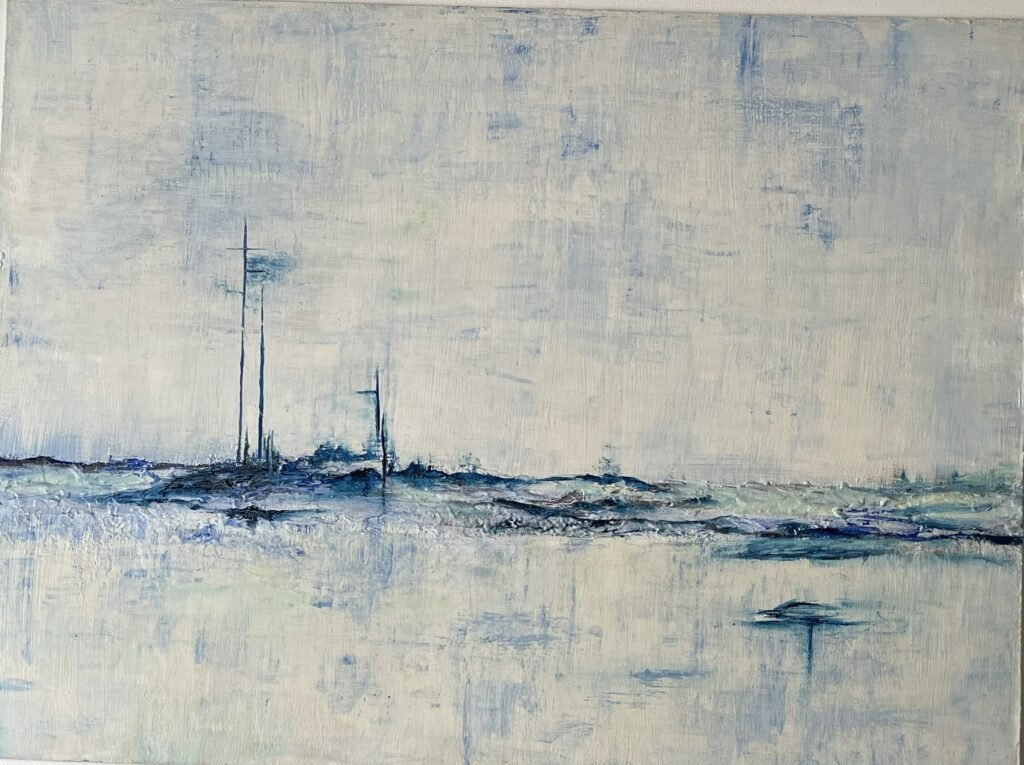
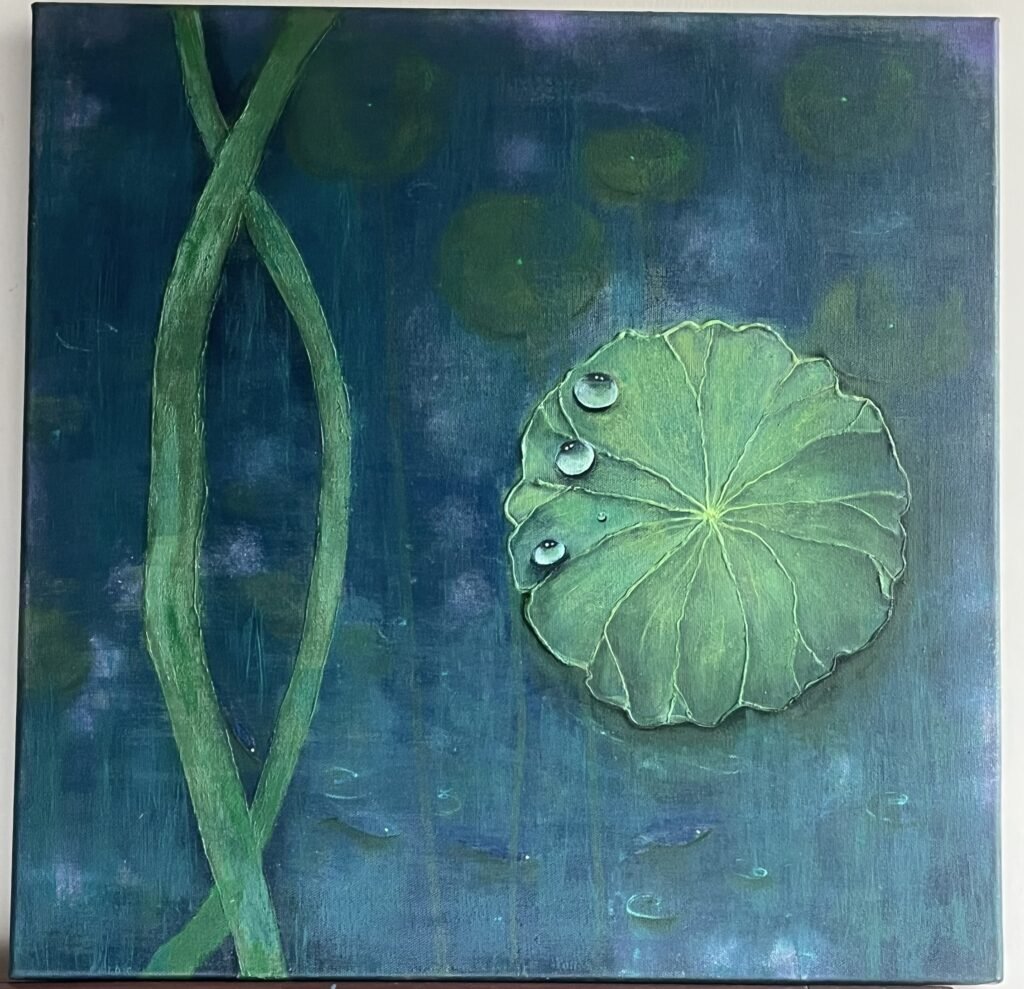
Basu’s current work is rooted in abstract painting and fluid experimentation.
Her approach allows colour and forms to develop without the obligation to depict a recognisable person, object or landscape. This freedom is important to her because it allows the painting process itself to become an experience.
She describes the canvas as a place where she can lose track of time and enter the present moment. A Sunday spent painting can pass without her noticing the hours.
This relationship between painting and presence is closely connected to her interest in spirituality and mindfulness.
Rather than treating mindfulness as a separate idea added to her art, she experiences it through the process of painting itself.
Basu’s artistic intention extends beyond her own studio experience.
She hopes that someone standing in front of one of her paintings might also experience a moment of stillness.
She does not necessarily expect viewers to decode the artwork or identify a particular subject. Instead, she hopes they might pause long enough to experience their own sense of the present. As she expressed during her conversation with Bhavkala, if someone can stand before her canvas and “find their now,” that would represent a meaningful success for her work.
This makes the viewer’s experience an important part of her artistic thinking.
The abstract canvas does not provide a fixed answer. It creates a space where the viewer can slow down and bring their own response to the work.
Basu’s movement toward abstraction also reflects a larger change in her relationship with art.
Her early experiences were closely connected with drawing, technical accuracy, oil painting and evaluation. Her current practice gives greater importance to freedom, fluidity and intuition.
The shift does not represent a rejection of everything she learned earlier. Instead, those experiences remain part of her understanding of materials, colour and surfaces.
Her early lessons about painting on boards, preparing surfaces and understanding how colour behaves continue to sit beneath the more spontaneous quality of her current work.
Although Basu’s public-health career and artistic practice operate in different spaces, her life demonstrates how both can coexist.
Her professional work is concerned with people and communities, while her painting practice creates a more inward space for reflection.
One is outward-facing and community-oriented; the other is personal and contemplative.
Together, they form two distinct ways through which she engages with human experience.
Basu’s return to art has also meant learning how to make creative decisions for herself rather than waiting for external validation.
She acknowledges that abstract work may not always be understood by people around her. Yet she has become increasingly comfortable with that uncertainty.
Her current practice therefore represents not only a change in visual style, but also a change in the purpose she assigns to art.
The question is no longer simply, Is this painting good?
Instead, the process begins with a different question: What happens when I allow myself to be completely present while making it?
At Bhavkala, where independent artists are presented through their personal stories and creative practices, Sharmishta Basu brings a perspective shaped by both professional research and a lifelong relationship with art.
From childhood drawing classes and oil painting in Kolkata to experimenting with fluid acrylics alongside her daughter, and eventually returning to abstract painting through the experience of COVID and mindfulness, her practice has evolved through different stages of life.
Today, the canvas gives her a place to slow down.
Her abstract paintings do not ask viewers to arrive with a predetermined interpretation. Instead, they offer an opportunity to pause, observe and experience.
For Basu, that quiet encounter may be the most meaningful part of the artwork.
If a viewer can stop for a moment, let go of the rush of everything else, and find their now in the painting, the canvas has already done what she hoped it would do.