People liked the post
Instagram: @swapnagopinathan
For more than two decades, Swapna Gopinathan worked in the corporate world, building a career in human resources across different cities and industries. Art, meanwhile, remained a quieter part of her life—something she returned to through painting, handmade cards, workshops and creative experiments.
Today, that relationship has changed.
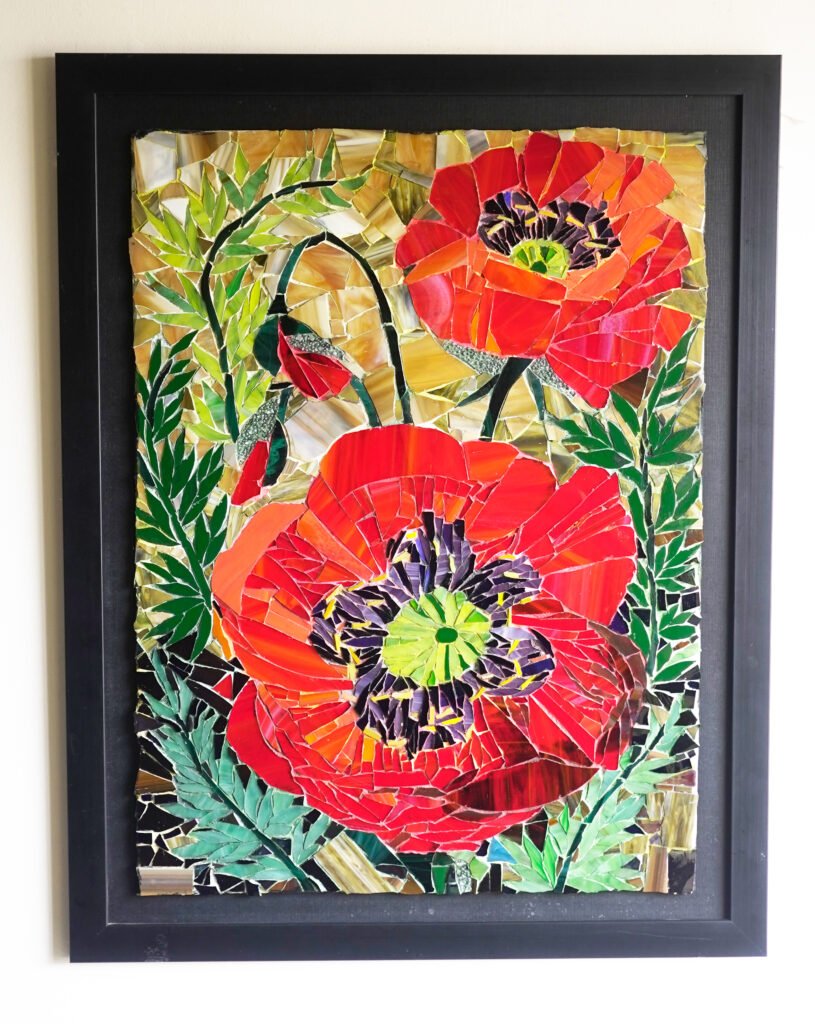
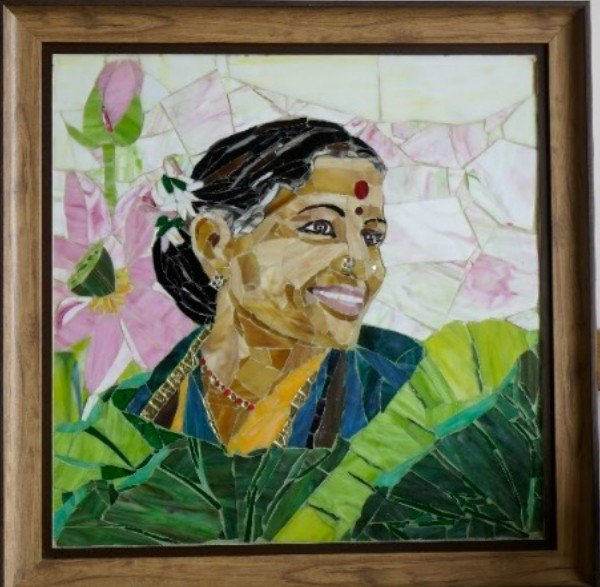
Gopinathan is developing a dedicated practice in stained glass mosaic, working with sheets of coloured glass that she cuts, shapes and assembles much like a painter uses individual brushstrokes.
Her journey from corporate HR to contemporary glass mosaic is not simply a career change. It is a story about rediscovering creativity, experimenting with material, and gradually allowing art to become an important part of her identity.
Gopinathan’s relationship with movement began early.
Growing up as an Army child, she moved with her family approximately every three years between different military stations across India. Constantly changing schools, cities and communities exposed her to different cultural environments and taught her to adapt to new surroundings.
Creativity was present throughout these years.
While her sister gravitated towards music, Gopinathan became the family’s visual creator. She made Christmas cards, birthday cards and other handmade pieces, treating creativity as a natural part of family life.
At school, she encountered very different educational environments—from makeshift classrooms in Assam to schools with more developed art facilities in Delhi.
Art, however, remained a hobby rather than a career she imagined for herself.
Gopinathan initially followed a more conventional academic path.
She completed her Bachelor of Science from Christ Church College in Kanpur and later pursued an MBA in Human Resources from Symbiosis Centre for Management and Human Resource Development in Pune, graduating in 2000.
Her professional career subsequently developed within corporate human resources.
Over more than twenty years, she worked across different organisations and cities, eventually reaching senior HR leadership roles in the diagnostics and life sciences sector.
The corporate world became a major part of her professional identity—but creativity never disappeared completely.
After spending more than twenty years in corporate HR, Gopinathan decided to step away from full-time corporate work.
The decision came after years of demanding professional responsibilities and a desire to reconsider the direction of her life.
Stepping away created something she had not previously had in quite the same way: time.
Time to experiment.
Time to attend workshops.
Time to make art.
And, perhaps most importantly, time to discover what kind of artist she wanted to become.
The transition was not immediately easy. After decades of introducing herself through her corporate role, calling herself an artist initially felt unfamiliar.
But gradually, the identity began to feel natural.
Gopinathan’s renewed artistic journey developed through workshops and experimentation.
One of the early steps was an enamel workshop, followed by further exploration of different creative techniques.
She had always painted, but workshops introduced her to materials and processes that were different from conventional painting.
Among these was mosaic.
She attended a workshop in glass mosaic around 2023–24, and the experience immediately drew her towards the medium.
What began as another creative experiment quickly became a sustained artistic practice.
Her paints, brushes and canvases gradually moved into the background, while glass became her primary material of exploration.
Gopinathan’s attraction to stained glass mosaic is strongly connected to its physical process.
She enjoys the concentration required to cut and shape glass. The repetitive process of cutting and nipping pieces creates an immersive experience that she describes as deeply absorbing.
Unlike a quick sketch or spontaneous painting, a mosaic demands patience.
Every piece has to be considered.
Every cut affects the composition.
Every colour interacts with the surrounding glass.
For Gopinathan, this combination of effort, concentration and focus is an important part of what makes the medium compelling.
One of the most distinctive aspects of Gopinathan’s practice is the way she approaches glass.
Traditional mosaic techniques often use relatively small, regular tesserae arranged to construct an image.
Gopinathan approaches the material differently.
She thinks about individual pieces of glass almost like brushstrokes.
Instead of asking the glass to imitate a conventional tiled surface, she cuts pieces according to the visual movement she wants to create.
A single shard can function like a painter’s stroke.
The shape, direction and colour of that piece contribute to the larger image.
This approach allows her stained glass mosaics to retain a connection with painting while taking advantage of the unique qualities of glass.
Gopinathan describes herself as a self-taught artist without formal art-school training.
Rather than viewing that as a limitation, her journey has involved actively seeking specialised teachers and artists who can help her understand particular techniques.
She has explored learning opportunities with artists and educators working internationally, including Adriana, an Argentina-based educator associated with stained-glass portrait techniques, and Jolene, a US-based educator known for highly detailed glass work.
For Gopinathan, developing an artistic practice involves knowing when to learn from someone else and when to experiment independently.
As her practice develops, Gopinathan continues to explore different subjects and themes.
One of her larger works is a 2-by-3-foot Kathakali artwork, which required approximately 80 hours of work and around 15–20 days of production time.
The scale of the work reflects an important characteristic of her process: patience.
Because each artwork requires substantial manual effort, she has also been thinking about how to balance smaller works with larger compositions.
She particularly enjoys working on larger pieces because they provide greater space for experimentation, although the amount of time involved remains an important consideration.
Gopinathan’s themes are also connected to her personal background and cultural experiences.
With family roots in Kerala and a childhood spent moving across India, she has developed an interest in subjects connected to different regions and cultural identities.
Kerala and South India are among the themes she is currently drawn towards, with ideas continuing to develop through her studio practice.
Her approach remains open-ended. Rather than locking herself into a single subject or visual formula, she continues to explore how different themes can translate into glass.
Glass mosaic is a medium that demands both technical control and patience.
For Gopinathan, sourcing stained-glass sheets in smaller quantities can itself be challenging. The material is often supplied through larger import channels, making access to artist-scale quantities more complicated.
She has had to navigate these practical aspects alongside the creative work—finding suitable glass, experimenting with colours and learning how different pieces behave when cut and assembled.
The material itself becomes part of the learning process.
Over the past two to two-and-a-half years, her approach to cutting, combining and using colour in glass has continued to evolve.
As her practice developed, Gopinathan also began entering the exhibition space.
She has set a goal of participating in approximately three to four exhibitions each year.
Her exhibition journey has included shows at Jawahar Kala Kendra in Jaipur and the India Habitat Centre in Delhi, where one of her artworks was sold.
She has also connected with other women artists through the India Mosaic Group, building a community around the medium and learning from other practitioners.
For an artist relatively early in her transition into full-time creative work, these exhibitions have become part of the process of establishing a public artistic identity.
Gopinathan’s artistic practice does not exist entirely separately from her corporate background.
One of the most interesting intersections between the two is her work with Kintsugi.
Kintsugi is the Japanese practice of repairing broken ceramics with gold. Beyond the physical technique, Gopinathan is interested in the philosophy associated with repair, resilience and wabi-sabi.
She conducts Kintsugi-based workshops for both corporate and community audiences.
Participants intentionally break a ceramic object and then rebuild it, highlighting the repaired cracks with gold.
The activity becomes a starting point for conversations around resilience, mindfulness, growth mindset, leadership and building stronger teams.
Her Kintsugi workshops reveal another side of Gopinathan’s creative practice.
Here, art is not simply about producing an object.
The act of breaking and repairing becomes a metaphor.
Participants are encouraged to reflect on each stage of the process, connecting physical repair with ideas about overcoming challenges, personal growth and resilience.
This work allows her previous HR experience and her artistic identity to exist together.
Rather than leaving her corporate career entirely behind, she has transformed elements of that experience into a different kind of creative engagement.
A large glass mosaic can appear visually effortless once completed.
Behind it, however, is a significant amount of manual work.
Gopinathan’s Kathakali piece, for example, required approximately 80 hours.
Her typical working rhythm often happens in the evening, when the rest of the household has gone to sleep.
This private studio time gives her the space to concentrate on cutting, assembling and refining the work.
The slow pace is not something she tries to eliminate.
It is part of the medium.
And it is precisely this combination of patience and concentration that continues to draw her towards glass.
Perhaps the most important part of Gopinathan’s story is not the change in medium but the change in identity.
For years, her professional introduction was defined by corporate HR.
Then came a period in which she had to introduce herself differently.
Artist.
The word initially felt difficult to claim after decades in another profession.
But through workshops, exhibitions, studio practice and continued experimentation, the identity gradually became more tangible.
Her journey demonstrates that an artistic career does not necessarily have to begin in childhood or through formal art education.
Sometimes it can emerge much later, after years spent developing an entirely different professional life.
Swapna Gopinathan’s journey into stained glass mosaic is still evolving.
She continues to experiment with scale, subject, colour and technique while learning from other artists and responding to the possibilities of glass.
Her work carries traces of her earlier life: the adaptability developed through constant movement, the organisational discipline of a long HR career, the curiosity of a lifelong maker, and the patience required to build an artwork one piece at a time.
In her hands, glass becomes more than a material.
It becomes a brushstroke.
A mosaic becomes more than an arrangement of fragments.
It becomes a slow process of attention.
And the transition from corporate professional to artist becomes not an abandonment of the past, but a way of bringing different parts of a life into the same creative space.
At Bhavkala, where art, material and individual creative journeys meet, Swapna Gopinathan’s practice offers a compelling example of what can happen when a long-suppressed creative instinct finally receives the time and space to grow.