People liked the post
Instagram: @speakingpicture_75
For Ashoo Sharma, mountains are more than landscapes to be photographed or painted. They are environments to be experienced, studied and understood through movement, observation and time.
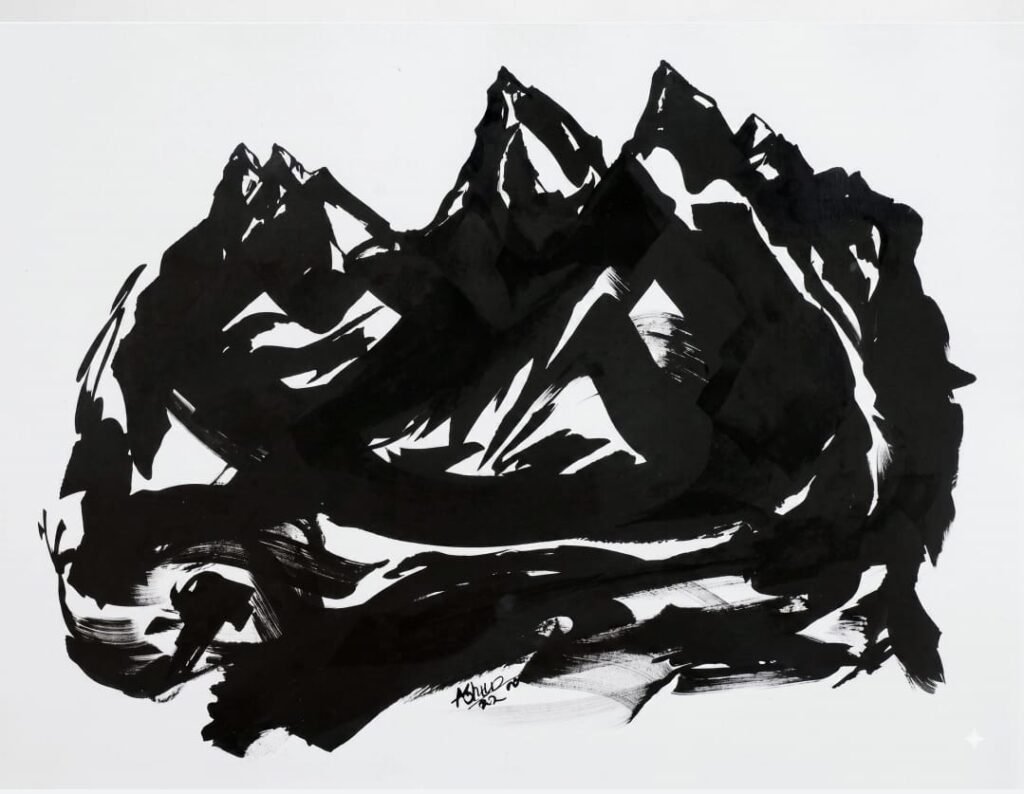
An artist, designer and travel photographer, Sharma has spent decades developing a creative practice centred around mountain landscapes, rock formations, geological structures and nature. His work brings together the disciplines of applied art, photography and landscape painting, translating his experiences of high-altitude environments through Chinese ink, dry pastels, dry crayons and large-scale watercolours.
At the heart of his practice is a sustained fascination with the physical character of mountains—their changing slopes, exposed rock, snow, valleys and formations shaped over geological time.
Sharma’s artistic foundation began with formal training in applied art. Between 1994 and 1997, he pursued a four-year diploma at the Jaipur School of Arts, Rajasthan School of Art. His interest in art and design was also shaped by his family environment, particularly his father, who was a painter and retired chief artist.
Growing up in Delhi, Sharma was exposed to drawing, visual design and photographic processes from an early stage. This background eventually led him toward professional work in design, fabrication and publication layouts.
His design career included assignments for publications such as Discover India and Namaste, giving him an early professional understanding of composition, visual communication and editorial imagery.
This foundation in applied art continues to inform the way he approaches landscapes today. Whether working with a camera or a paintbrush, his practice is grounded in close observation of form, proportion, texture and spatial relationships.
Around 1997, Sharma began developing his practice in travel and adventure photography alongside his design work. His photography assignments took him beyond the studio and into natural environments, where the landscape itself became his subject of study.
Photography offered him a way to observe the changing character of mountains in real time.
High-altitude light can dramatically alter the appearance of a rock face. Shadows reveal ridges, cracks and textures, while changing weather conditions transform the colour and atmosphere of an entire landscape.
For Sharma, the camera became more than a tool for recording a journey. It became a means of studying the physical structure of the places he travelled through.
That photographic observation would later feed directly into his paintings and drawings.
One of the defining subjects in Ashoo Sharma’s work is the geology of mountain landscapes.
His interest extends beyond the conventional idea of a scenic mountain view. He pays particular attention to the structural differences found at different altitudes—the gradual slopes of lower regions, exposed rock at higher elevations, narrow valleys, dramatic ridges and unusual formations.
These formations become visual subjects in their own right.
Rock faces can appear almost abstract when observed closely. Lines, fractures, shadows and layers create patterns that can be translated into drawing and painting without necessarily becoming literal reproductions of a particular location.
This is where Sharma’s background in both design and photography becomes particularly relevant: he observes the landscape structurally, paying attention not only to what it looks like, but also to how its forms interact.
Sharma works across several traditional drawing and painting mediums, including Chinese ink, dry crayons, dry pastels and large-scale watercolours.
Each medium offers a different way of interpreting the physical character of the mountains.
Chinese ink allows Sharma to work with strong contrasts, fluid marks and expressive lines. It is particularly suited to representing the darker structures of rocks, snowlines and geological fractures.
Dry crayons and pastels allow him to explore the weathered surfaces and tonal variations of exposed rock. Their texture can suggest the rough, chalky and abrasive character of mountain formations.
Watercolour introduces another dimension through transparency and layered washes. Sharma uses the medium to explore atmospheric changes, shadows and the expansive quality of alpine landscapes.
Together, these mediums allow him to move between precision and expression, translating physical observations into a more interpretive visual language.
The relationship between photography and painting is central to understanding Sharma’s practice.
Photography allows him to capture a particular moment—the light falling across a ridge, the texture of a rock wall or the scale of a valley. Painting gives him the opportunity to reinterpret those observations through line, pigment, texture and composition.
The two practices therefore operate in dialogue.
His photographs record his encounters with the landscape, while his paintings and drawings transform those observations into another form of visual experience.
Sharma’s connection with mountains is also deeply physical.
His experience includes extensive trekking and high-altitude expeditions across Uttarakhand, including the Valley of Flowers, as well as regions close to the Indo-China border.
These journeys have allowed him to experience mountain environments directly rather than simply observing them from a distance.
High-altitude conditions introduce changing weather, intense ultraviolet exposure, difficult terrain and dramatic differences in scale. Moving through such environments creates an understanding of the landscape that is difficult to obtain through photographs alone.
For Sharma, this first-hand experience becomes part of the artistic process.
The mountain is not simply a subject—it is a place physically encountered through walking, trekking and exploration.
Years of travelling through high-altitude environments have also brought Sharma into close contact with the environmental challenges affecting mountain regions.
During his expeditions, he has observed concerns related to increasing tourism, overcrowding and inadequate waste management, including the accumulation of plastic along trekking routes.
These observations have contributed to his wider involvement with environmental preservation.
Sharma has been associated with trekking groups and tree plantation initiatives, reflecting his interest in protecting the environments that have played such an important role in his creative life.
For him, experiencing nature also brings a responsibility to consider how these landscapes are treated.
The environmental dimension of Sharma’s work adds another layer to his mountain imagery.
His photographs and artworks draw attention to the physical character of landscapes while his experiences in the field have made him aware of their vulnerability.
Rather than presenting mountains only as picturesque destinations, his practice encourages viewers to consider them as complex natural environments—places shaped by geological processes and affected by human activity.
This relationship between visual observation and environmental awareness is particularly relevant to contemporary landscape art, where the representation of nature can also become a way of thinking about its preservation.
Across photography, drawing and painting, Sharma’s approach is rooted in looking closely.
His applied-art education taught him the importance of structure and visual composition. His work in publication design developed his understanding of visual communication. Photography took him into the field, where he could study landscapes directly. And his painting practice allowed him to reinterpret those observations through different materials.
The result is a multidisciplinary practice that moves between design, photography and fine art.
Sharma’s work also opens possibilities for presenting mountain imagery within contemporary exhibition and design environments.
His discussions with Bhavkala have explored the presentation of mountain photography through large-format prints, including formats around 20 × 30 inches and 24-inch works, alongside original ink and watercolour pieces.
This creates opportunities for his work to engage not only traditional art audiences, but also architects, designers, collectors and people interested in the relationship between art and natural environments.
Ashoo Sharma’s artistic journey demonstrates how applied art, travel photography, landscape painting and physical exploration can converge into one practice.
His mountains are not distant images viewed from afar. They emerge from years of travelling, trekking, photographing, drawing and observing.
Through Chinese ink, dry pastels, crayons, watercolour and photography, Sharma continues to interpret the structures of high-altitude landscapes—their rock formations, slopes, textures, shadows and geological character.
For Bhavkala, his work offers an opportunity to look at mountains differently: not simply as spectacular scenery, but as living environments with histories, structures and vulnerabilities of their own.
Explore Ashoo Sharma’s mountain landscapes and discover how photography, art and direct experience come together in his evolving visual practice.