Instagram: @raashidartist
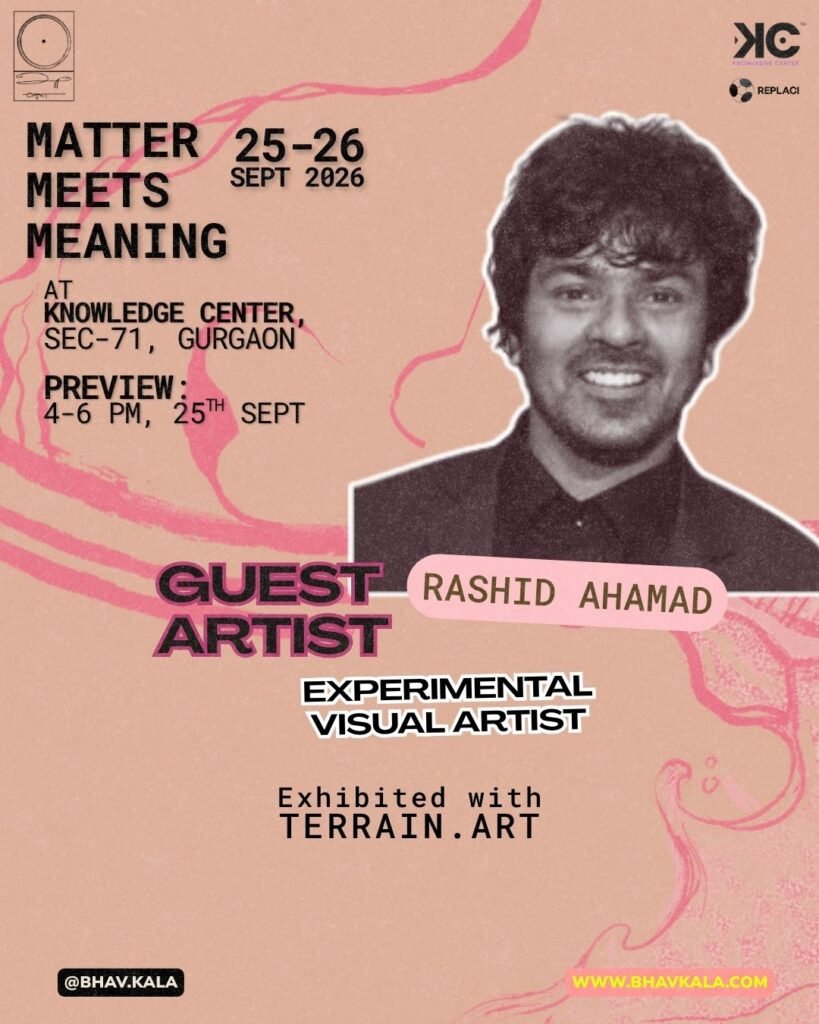
Rashid Ahamad is an Indian painter and experimental visual artist whose practice explores the intersection of spirituality, nature, meditation, the cosmos and human experience. Working primarily with acrylic and mixed media, Ahamad creates abstract compositions using colour, texture, lines and dots to express ideas that move between the visible and the intangible.
Born in 1987, Ahamad has been active as an artist since 2013. His artistic journey has evolved through continuous experimentation, drawing and painting, eventually leading him towards abstraction as a way of achieving greater creative freedom. His works invite viewers to contemplate relationships between the microcosm and macrocosm, creation and destruction, harmony and chaos, and the natural and cosmic worlds.
Ahamad’s artistic journey began with a strong interest in drawing. During his years at the University of Allahabad, he developed his skills through persistent practice and extensive sketching. He has spoken about spending long hours sketching at Allahabad Railway Junction, an experience that became an important part of his development as an artist.
He completed his Bachelor of Fine Arts from the University of Allahabad in 2011 before moving to Delhi for his Master of Fine Arts from the College of Art, University of Delhi, in 2013. His education provided him with an opportunity to explore drawing, painting, large-scale canvases and different approaches to contemporary art.
While his early practice was connected to more concrete forms and drawing, his work gradually moved towards abstraction. Ahamad describes abstraction as a space that gives him greater freedom to experiment with form, technique and ideas.
Ahamad’s practice has been influenced by a diverse group of artists from Indian and European art histories.
Among the Indian artists he has discussed as important influences are M. F. Husain, Tyeb Mehta, Jogen Chowdhury, K. G. Subramanyam, J. Ram Patel, S. H. Raza and V. S. Gaitonde. He has particularly discussed his interest in Tyeb Mehta’s lines, Jogen Chowdhury’s distinctive mark-making, and the abstract approaches of J. Ram Patel, S. H. Raza and V. S. Gaitonde.
His engagement with S. H. Raza’s Bindu became particularly significant as he explored the possibilities of abstraction. The simplicity and concentration of the Bindu encouraged him to investigate the expressive potential of dots and circular forms within his own practice.
European masters such as Leonardo da Vinci and Michelangelo have also influenced his thinking about artistic dedication, observation and discipline.
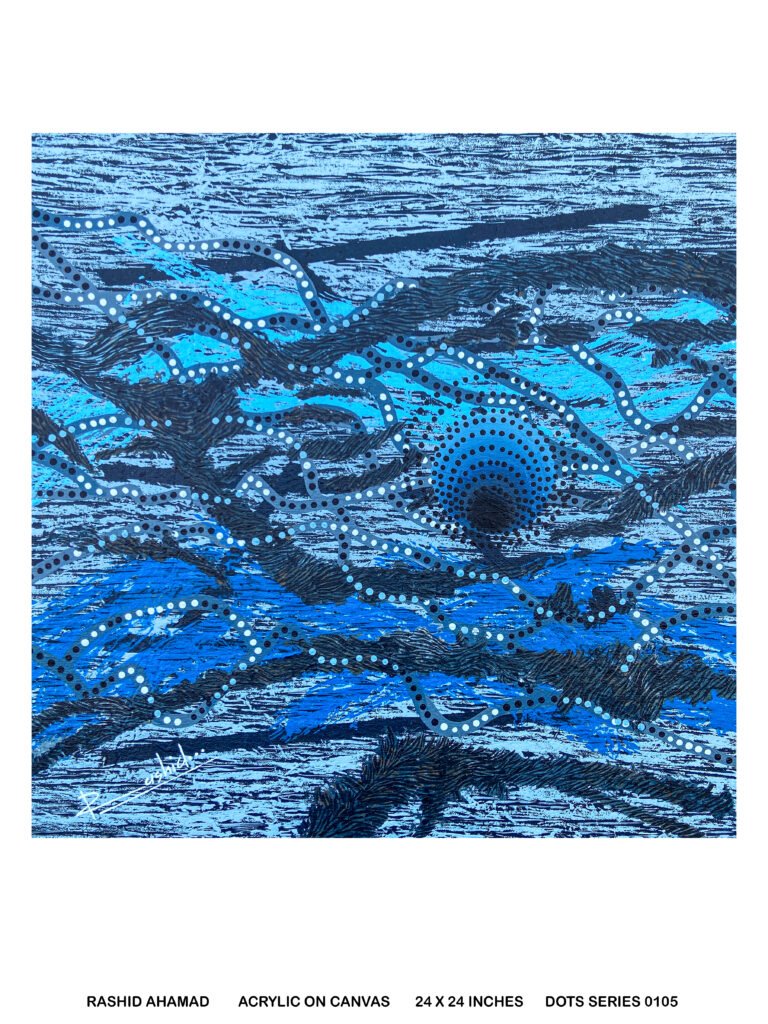
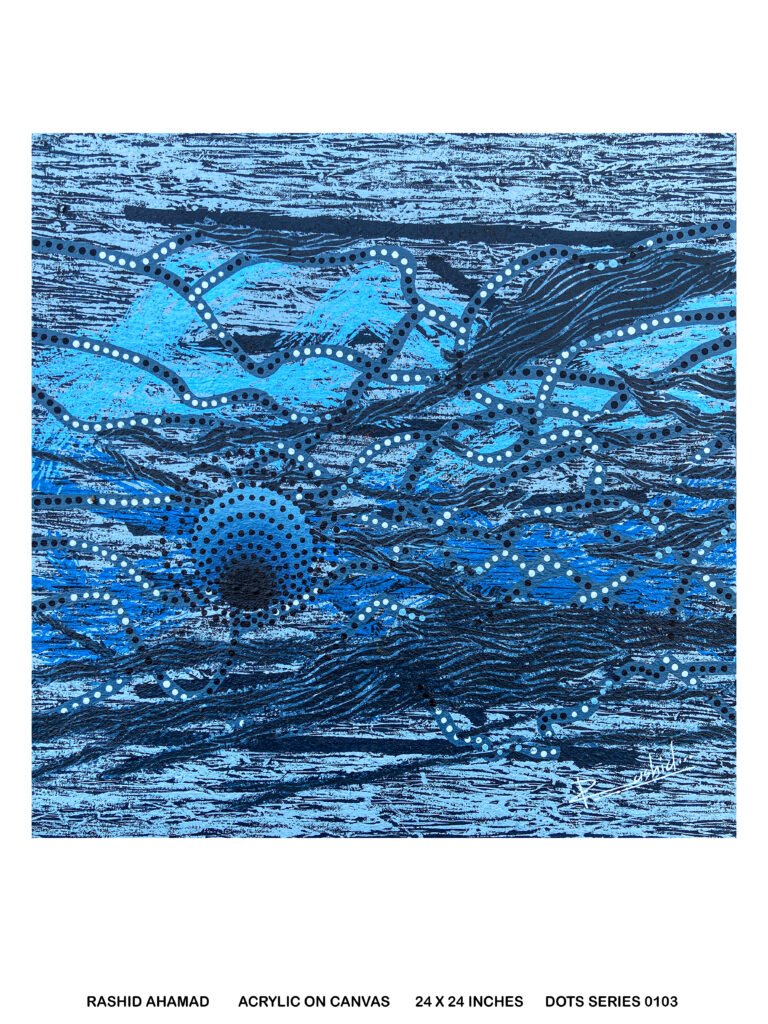
One of the most recognisable directions in Rashid Ahamad’s recent practice is his engagement with dots.
Terrain.Art has presented his “Bindu : Dots Series”, including works such as Dots Series 0041 and the Union of Soul and Divine – Dots Series.
The use of dots provides Ahamad with a visual language through which he can explore repetition, rhythm, density and the relationship between individual elements and a larger whole.
His work Union of Soul and Divine – Dots Series 0094, for example, is listed by Terrain.Art as an acrylic on canvas measuring 60 × 48 inches, demonstrating his engagement with large-scale abstract compositions.
The title itself points toward the spiritual dimension that runs through his practice: the relationship between the individual and something larger than the self.
Spirituality is central to Ahamad’s artistic vocabulary. Rather than presenting spirituality through a literal or figurative representation, he explores it through abstract forms, colour, lines, textures and dots.
His paintings reflect an interest in the connections between the individual and the universe. Terrain.Art describes his practice as engaging with the microcosm and macrocosm, as well as the relationships between the natural and cosmic, serene and tumultuous, and creation and destruction.
This approach allows his paintings to remain open to interpretation. Instead of prescribing one fixed narrative, the abstract compositions encourage viewers to engage with them through their own perceptions and experiences.
Ahamad works extensively with acrylic, a medium he values for its flexibility and possibilities for experimentation.
In his conversation with Terrain.Art, he explains that he initially worked with oil but found acrylic more suitable for the kind of freedom and experimentation he wanted in his practice. The faster working possibilities of acrylic enabled him to explore techniques and ideas more freely.
His practice also extends into mixed media, reflecting his continuing interest in experimenting with surfaces, materials and techniques. He has discussed future possibilities involving hard surfaces such as plywood alongside canvas.
Scale is another important element of Ahamad’s artistic ambitions.
His practice has increasingly explored large canvases and expansive abstract compositions. He has expressed an interest in creating wall-sized experimental works, allowing the physical scale of the artwork to become part of the viewer’s experience.
This interest in scale complements his exploration of cosmic and spiritual ideas. Large surfaces provide room for repeated marks, dots, textures and movements to develop into immersive visual environments.
Rashid Ahamad’s work has been presented across national and international platforms.
His exhibition history includes the International Museum Day exhibition at Allahabad Museum in 2022, as well as exhibitions at the National Art Gallery, Maldives; Niv Art Gallery, Delhi; and Russian Culture Centre, Delhi.
He has also participated in significant art camps, exhibitions and workshops, including the 15th International Art Exhibition at Lalit Kala Academy, New Delhi (2015), the SAARC Artist Camp in Maldives (2013), the 9th Bharat Bhawan International Biennial of Print-Art (2011) and the Atulya Bharat National Art Camp at NCZCC, Allahabad (2018).
His recognitions include the Landscape in Best Award at Srijan Sanwad Pradarshan, University of Allahabad (2008), the Swatantra Chetna Laudable Talents Honour (2008) and the Visual Arts Scholarship from Sahitya Kala Parishad, Delhi, for 2018–2019.
At the heart of Ahamad’s practice is a desire to use art as a means of communicating ideas and emotions that may not always be expressed through words.
His transition from drawing and concrete forms to abstraction reflects an ongoing search for a visual language that gives him greater freedom. Through dots, lines, colours and textures, he creates compositions that connect personal experience with larger questions about existence, spirituality and the universe.
His work does not simply seek to represent the world around us. Instead, it explores the spaces between the visible and invisible, individual and universal, material and spiritual.
Rashid Ahamad’s practice contributes to the diverse landscape of contemporary Indian abstraction. His engagement with the traditions of Indian modernism, combined with his personal exploration of spirituality and the cosmos, creates a practice rooted in both artistic study and experimentation.
His Dots Series demonstrates how a seemingly simple visual element can become the foundation for an expansive artistic vocabulary. Through repetition and variation, dots can suggest movement, energy, interconnectedness and infinite possibility.
For viewers, his paintings offer an opportunity to step away from literal representation and engage instead with colour, rhythm, texture and emotion.
Rashid Ahamad’s artistic practice brings together abstraction, spirituality, experimentation and contemporary Indian art. His paintings encourage viewers to consider the relationships between the individual and the universe, nature and the cosmos, and order and movement.
His engagement with dots, lines, colour and texture transforms the canvas into a space for reflection and interpretation. Through his evolving practice, Ahamad continues to explore how abstract art can communicate experiences and ideas that extend beyond the immediately visible.
His participation in the contemporary art landscape adds another perspective to conversations around art, spirituality, materiality and the human connection with the universe.