Instagram: @wish_art_artist
A mandala begins at the centre.
From that central point, lines, circles, patterns and layers gradually expand outward, creating a composition that demands attention and patience.
For Vishakha Sahdev, this process became a way of finding that centre within herself.
Her journey into art did not begin with formal training at an art school. It emerged much later, during a period of repeated relocations, interrupted professional plans and long stretches of time spent alone.
What began with pencil and pen mandalas eventually developed into large-scale acrylic mandala paintings on canvas, incorporating geometric structures, Indian cultural heritage and spiritual imagery.
Today, Sahdev is building her artistic practice while continuing to explore what mandala can become when it moves beyond the traditional small-format surface and enters the scale of contemporary canvas art.
Vishakha Sahdev was born and brought up in Jabalpur, Madhya Pradesh, where she completed her schooling and undergraduate studies.
Her academic journey has been diverse. She completed a Bachelor of Commerce, Master of Commerce, Bachelor of Education and Master of Arts in Hindi Literature.
Her education reflects a willingness to explore different disciplines rather than follow a single predetermined path.
That same openness would later become visible in her artistic practice.
Sahdev entered professional life early.
During the second semester of her B.Com., around 2012, she began working at a travel and tourism academy, where she was employed as a receptionist.
The academy trained students for aviation and related courses.
After approximately a year, her career moved towards education.
She joined Kangaroo Kids International School, where she taught nursery students for around three years while completing her B.Com. and M.Com.
Her experience in an international-school environment also gave her opportunities to incorporate creative activities into teaching. Art was present in classroom decoration, school projects, blackboard work and special assemblies, even though she did not yet consider herself an artist.
Sahdev later received an opportunity to teach Hindi in an international-school setting.
The role appealed to her because the school was looking for an approach to Hindi teaching that incorporated activities and engagement rather than relying only on conventional classroom methods.
Alongside teaching, she continued her education and eventually completed her M.A. in Hindi Literature.
Her academic and professional journey continued until marriage in 2020, after which her circumstances changed significantly.
Marriage brought another major transition.
With her husband’s military postings, Sahdev moved between different locations, including Rajouri, Bhopal, Faridabad and Suratgarh.
These repeated relocations made it difficult to establish a continuous professional career.
At one point, she spent an extended period at home while her husband was away for long working hours.
The experience left her searching for something that could provide a sense of focus and personal fulfilment.
That search eventually led her to mandala art.
Sahdev initially began creating pencil and pen mandalas.
The attraction was not simply visual.
The repetitive nature of mandala-making required her to concentrate completely on the paper—the lines, shapes and individual patterns.
That attention offered a sense of peace and satisfaction.
As she described during the interview, the process gave her something to focus on during periods when she was otherwise spending long stretches of time alone.
The mandala became a form of creative grounding.
It gave structure to an otherwise uncertain period.
The early pencil mandalas eventually evolved.
Sahdev began experimenting with brushes, paint and acrylics, gradually moving from paper-based mandala work to painted compositions.
This transition also opened up the possibility of working at a much larger scale.
She noticed that many mandala artworks were traditionally created on surfaces such as MDF boards and that there was an opportunity to explore large-scale mandalas on canvas.
That observation became an important direction in her emerging practice.
Around seven to eight months before her Bhavkala interview, she began seriously exploring large canvas mandalas.
Scale is an important part of Sahdev’s artistic exploration.
Rather than limiting mandala compositions to small decorative surfaces, she began developing larger canvas works intended for exhibition spaces.
This shift changes the experience of viewing the mandala.
At a larger scale, geometric structures have more room to unfold. The viewer can observe the relationships between individual lines, concentric forms, patterns and surrounding details.
For Sahdev, the move to canvas was therefore not simply a change of material.
It became a way of asking how a familiar visual language could occupy a more expansive contemporary format.
At the heart of Sahdev’s practice is a highly detailed approach to geometry.
Her mandalas rely on repeated forms, symmetry and carefully structured patterns.
The process demands concentration because each layer contributes to the balance of the whole composition.
This technical discipline is also part of the quality that Bhavkala noticed during the interview, describing her artwork as particularly clean and detailed. Sahdev herself, however, emphasised that she is still exploring the medium and considering different possibilities within it.
Her practice is therefore not presented as a finished formula.
It remains a developing visual language.
Sahdev’s recent works move beyond abstract pattern-making.
Her mandalas draw from Indian cultural heritage and spiritual imagery, bringing geometry together with ideas that have personal meaning for her.
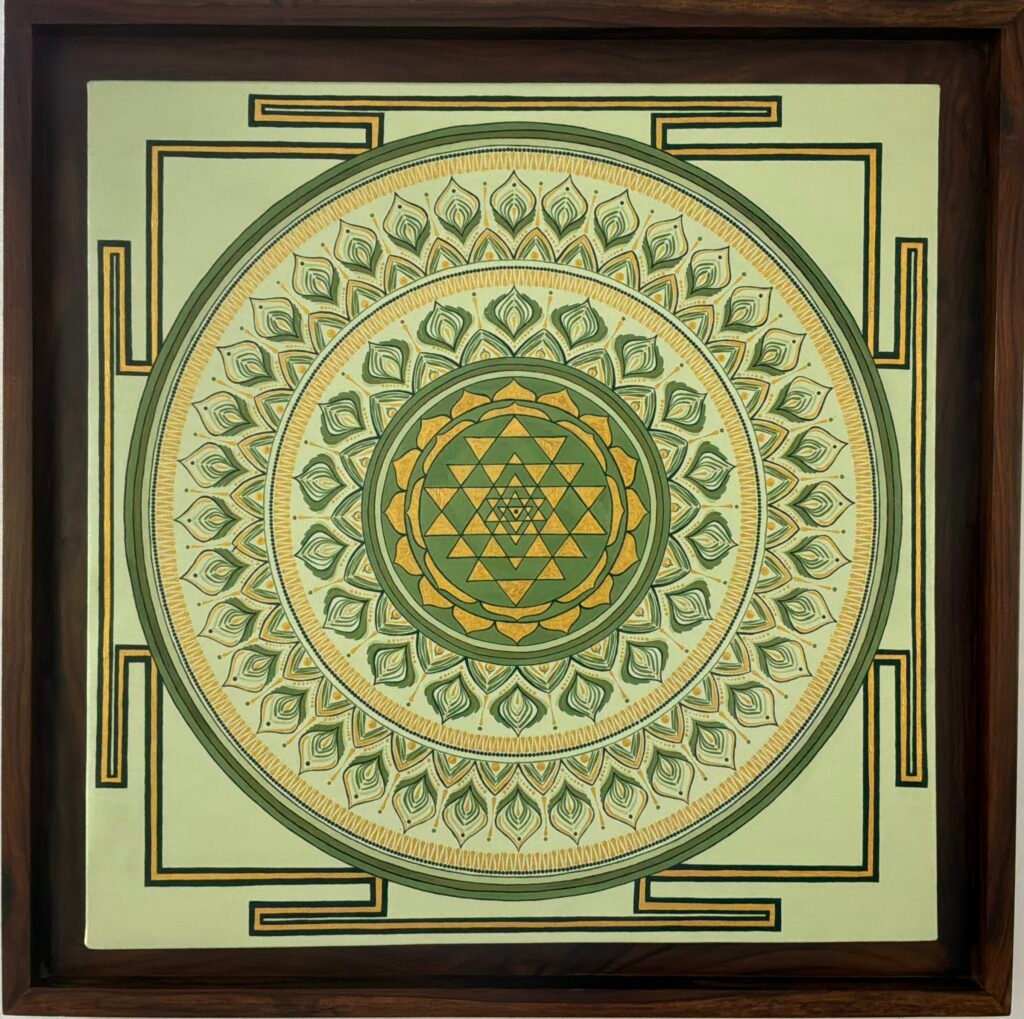
One of the works she presented during the interview was a Shriyantra painting.
The Shriyantra’s layered geometric structure provided a foundation for her composition, allowing her to explore the relationship between the central point, surrounding geometry and expanding layers.
For Sahdev, these elements are connected to Indian cultural heritage and spiritual ideas.
Her interest in such imagery also reflects her own spiritual background and personal relationship with these themes.
The Shriyantra painting represents an important direction in Sahdev’s current work.
Rather than treating geometry purely as decoration, she associates the central point and expanding structure with divine energy and the movement from the core outward.
The composition uses layers and petals to develop a visual sense of expansion.
This relationship between centre and circumference mirrors the fundamental structure of mandala itself: a concentrated point becoming an increasingly complex world of patterns.
For Sahdev, geometry therefore carries both visual and spiritual significance.
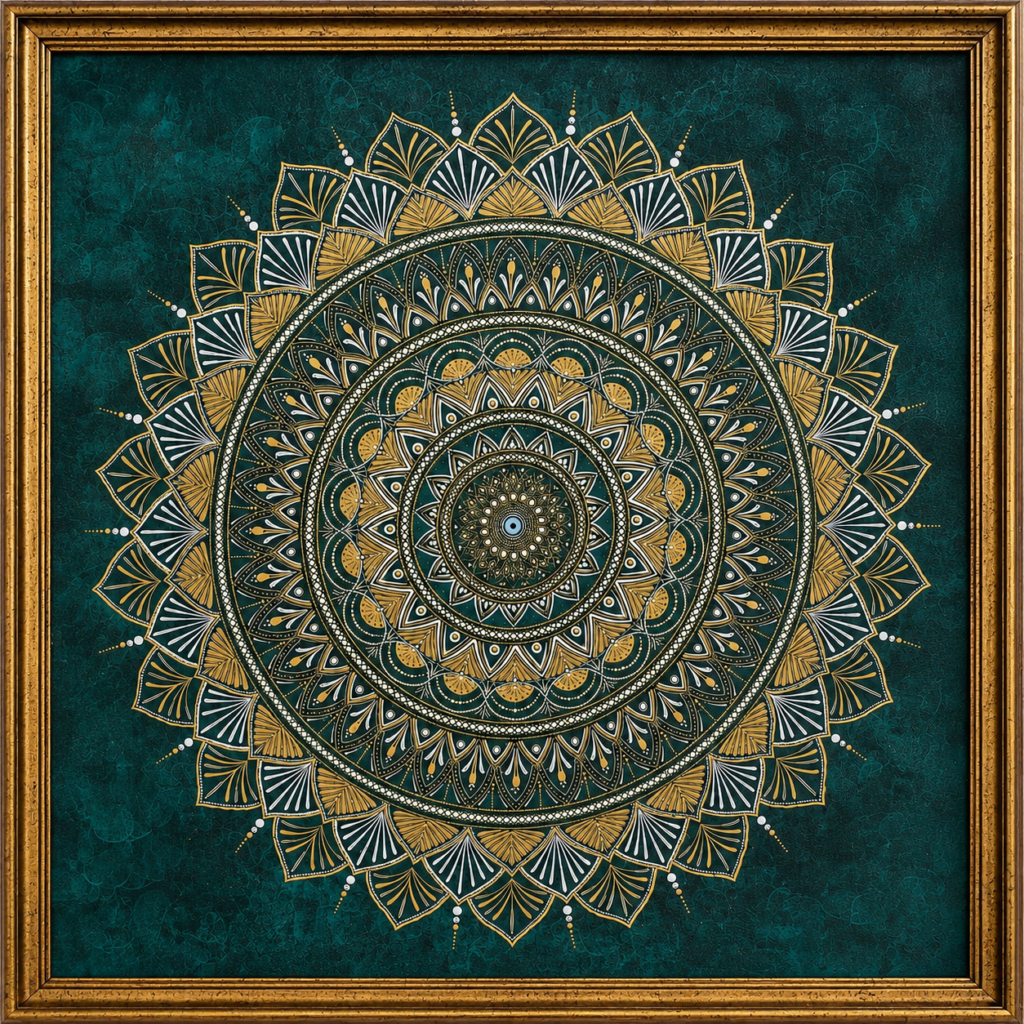
Another artwork presented during the interview was titled Swarna Abha (The Golden Aura).
Gold plays a central role in the work.
Sahdev explains her choice of golden colour through its association with divine energy.
The mandala’s centre becomes the starting point from which this energy is imagined as moving outward.
The title and colour therefore work together with the geometry of the painting rather than functioning simply as aesthetic choices.
The work demonstrates how Sahdev uses colour symbolically within her otherwise highly structured compositions.
Sahdev’s interest in spiritual imagery is connected to her personal background and her engagement with Indian texts and cultural traditions.
During the interview, she discussed references to the Bhagavad Gita and the ideas of consciousness, focus and different layers that have informed her understanding of these works.
These references become part of the conceptual framework through which she approaches her mandalas.
The resulting paintings combine three distinct elements:
geometry, colour and meaning.
The geometric structure provides order.
Colour establishes atmosphere and emphasis.
Spiritual and cultural references give the composition a deeper conceptual context.
Sahdev’s transition into professional art has happened relatively recently.
Although creativity was present during her school and teaching years, she began seriously developing her mandala practice only in the more recent period.
Her first exhibition took place at Pacific Mall through an organisation associated with the Army community.
The positive response to her work encouraged her to explore the professional art circuit further.
This was followed by participation in exhibitions associated with Art Spectra, including an IFEX exhibition, as well as presentations at Lod Art Gallery and the India Habitat Centre.
By the time of the interview, she had participated in several exhibitions but continued to describe herself as new to the professional art world and actively exploring the medium.
One of the most important aspects of Sahdev’s journey is that she does not present her current practice as completely defined.
She is still experimenting with mandala, scale, materials and visual possibilities.
Her journey from pencil and pen to acrylic and canvas is evidence of that evolution.
The large-scale canvas itself emerged from experimentation.
Her engagement with spiritual themes has developed through her personal interests.
And her exhibition journey is still relatively new.
This openness gives her practice room to grow rather than restricting it to a fixed visual formula.
Looking back, the foundations of Sahdev’s artistic practice were present long before she began exhibiting professionally.
They appeared in school projects.
In classroom decoration.
In drawing while explaining lessons.
In creative activities at international schools.
And eventually, in the quiet hours created by a life of frequent relocation.
These experiences did not immediately produce an artist.
But they created a familiarity with visual expression that was waiting for the right medium and the right moment.
Mandala provided that opening.
For Sahdev, the development of an artistic practice also provided something that frequent relocation had made difficult: a consistent personal space.
Cities could change.
Schools could change.
Professional opportunities could change.
But the mandala offered an activity she could carry with her.
The paper, pencil, brush and canvas became a constant.
This may be one reason the idea of grounding is so closely connected to her practice.
Her artworks are constructed through repetition and structure, even as her own life has involved considerable movement.
At present, Sahdev’s studio is still developing.
She works from her room rather than from a dedicated professional studio and is in the process of creating a more permanent setup.
Her current base is connected to Hansi, while her family circumstances continue to involve travel and relocation.
The unfinished studio is therefore another reflection of an artistic journey that is still taking shape.
The practice exists first.
The formal infrastructure is gradually following.
There is an interesting parallel between Sahdev’s artwork and her journey.
A mandala begins with a centre.
From that centre, everything else develops outward—layer by layer, line by line and pattern by pattern.
Sahdev’s artistic journey has followed a similarly gradual process.
Her education created one layer.
Teaching created another.
Marriage and relocation changed the direction.
Pencil mandalas provided a point of focus.
Acrylic introduced colour and scale.
Canvas opened the possibility of larger compositions.
Exhibitions brought the work into a public space.
And spiritual and cultural imagery gave the practice an increasingly personal vocabulary.
Vishakha Sahdev is still early in her professional artistic journey, but the direction of her work is already becoming distinct.
Her large-scale acrylic mandalas combine precision with personal meaning, bringing together geometric structures, Indian cultural references and spiritual imagery.
Her works such as Shriyantra and Swarna Abha (The Golden Aura) demonstrate an interest in using the mandala not only as a pattern, but as a visual structure through which ideas of energy, consciousness, heritage and inner focus can be explored.
At Bhavkala, where independent artistic journeys are placed in conversation with contemporary visual culture, Sahdev’s practice offers a reminder that an artistic language can emerge gradually.
Sometimes it begins with a pencil.
Sometimes it begins with a need for stillness.
And sometimes, from that quiet centre, an entire visual world begins to unfold.