
Instagram: @shana_sood
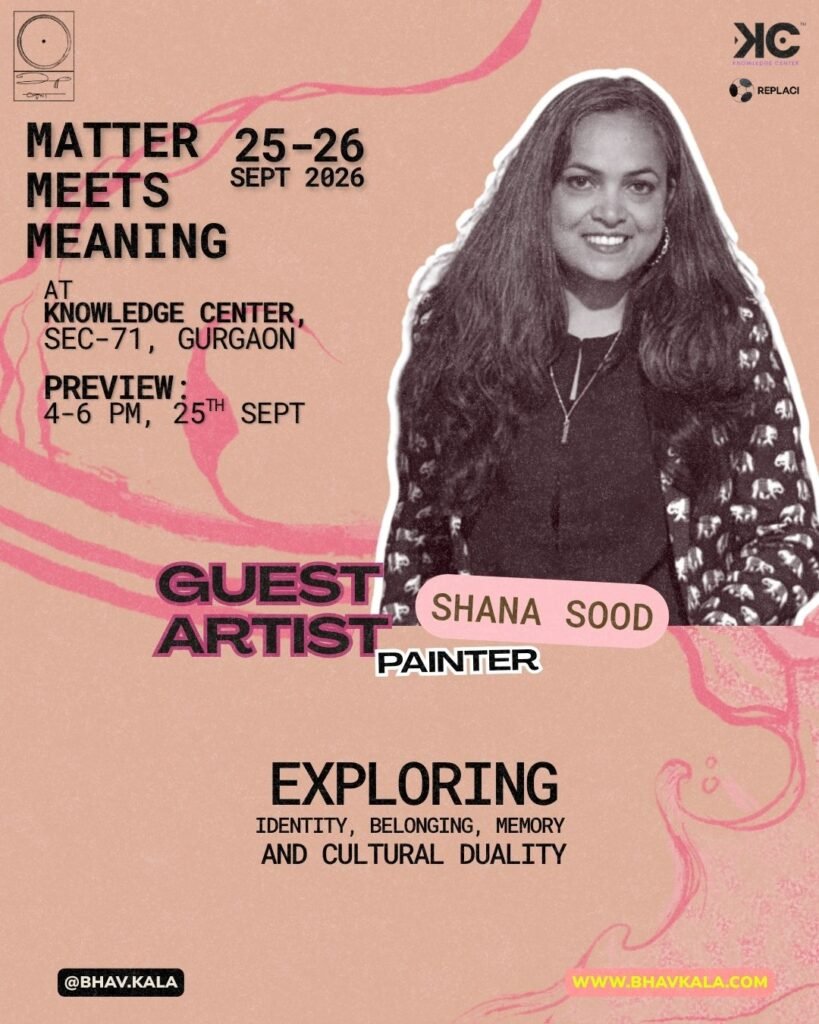
What does it mean to carry a place within you even when you are living far away from it? For Indian-born artist Shana Sood, painting becomes a way of exploring this question through memory, identity, cultural inheritance and belonging.
Born and raised in New Delhi and later moving to the United States, Sood’s artistic practice occupies the space between remembered experiences and present-day life. Her paintings draw upon lived memory, emotional recollection and her continuing relationship with India, creating intimate visual narratives around womanhood, family, migration and cultural identity.
Her work is featured in Mirrors: Distance Between Worlds, a dual exhibition bringing together Sood and Cuban-American artist Yolanda Peña Mazzoni. Curated by art critic and curator Georgina Maddox, the exhibition considers the connections between migration, memory, identity and cultural inheritance through the perspectives of two artists from different diasporic backgrounds.
Shana Sood was born and raised in New Delhi before moving to the United States in 2005. Although art was always an important part of her life, family responsibilities initially led her toward a more conventional path. Her later return to painting developed into a significant artistic practice, with recent exhibitions in India becoming a form of personal and artistic homecoming.
Sood describes Delhi as a place filled with sensory experiences, colours, textures and stories, while Himachal, where her roots lie, represents a quieter and more meditative landscape. These contrasting memories contribute to the emotional geography that appears throughout her work.
Today, Sood lives and works in the Washington, D.C. area. Her artistic journey has also included several formative years within the New England arts community.
Sood is a self-taught artist whose visual language has developed through sustained practice, community support and inspiration from artists including Amrita Sher-Gil and Henri Matisse. Her work has been exhibited across New England and in India.
Rather than treating memory simply as a record of the past, Sood uses it as an active source for painting. Her works explore the India that exists through recollection—an India shaped by childhood experiences, cultural traditions, family histories and the emotional distance created by migration.
This relationship between memory and place is central to understanding her practice. The India represented in her paintings is not necessarily a literal geographical representation. Instead, it is an emotional landscape that continues to evolve through distance and remembrance.
One of the defining aspects of Shana Sood’s work is her exploration of diasporic identity. Living in the United States while maintaining a strong emotional connection with India creates a dual perspective within her paintings.
Sood has described her work as expressing a longing that is both personal and collective, particularly through the experience of living in the USA while retaining an emotionally vivid connection with India.
Her paintings therefore exist between two worlds. They consider what happens when cultural identity is carried across borders and generations, and how memories of home change when viewed from a distance.
As Sood explains in the exhibition catalogue, being an Indian artist in the United States gives her the freedom to explore identity while also carrying the imprint of the past.
Sood’s practice is rooted in figurative realism infused with symbolism. Portraits, domestic spaces and everyday moments become vehicles through which she examines cultural inheritance, womanhood and displacement.
Colour plays an especially important role in her visual vocabulary.
Rich reds, ochres and earthy tones recur across her paintings, conveying associations with ritual, resilience and cultural endurance. The exhibition catalogue particularly identifies deep red as an important colour within Sood’s practice—a hue connected to memory, passion and cultural belonging.
Her use of colour allows ordinary scenes and figures to carry emotional weight. A face, a mother and child, a woman in a domestic setting or a remembered landscape can become part of a much larger conversation about identity and belonging.
Several works in the exhibition directly engage with Sood’s relationship with India. Her series and paintings include titles such as The India I Carry – Mother and Child, The India I Carry – Girl’s Gaze, The India I Carry – Himachali Bride, The India I Carry – Garmi ki Chhuttiyan (Summer holidays), The India I Carry – Street Hawker and The India I Carry – Tibetan Woman.
These works demonstrate the breadth of her engagement with remembered Indian experiences.
For example, The India I Carry – Mother and Child is an oil painting measuring 16 × 20 inches, created in 2026. The India I Carry – Girl’s Gaze is another 16 × 20 inch oil painting from 2025, while The India I Carry – Himachali Bride is an acrylic on canvas from 2019.
Together, these works suggest an artistic archive built from people, places, relationships and visual memories.
Sood’s exhibition works span multiple periods and techniques, including oil and acrylic painting as well as mixed media.
Some notable works include:
The variety of titles itself reveals recurring ideas in Sood’s practice: inheritance, memory, nostalgia, belonging, transformation and the experience of becoming something—or someone—else.
Women occupy an important place within Sood’s visual world. Her figurative paintings frequently turn toward female identity, family relationships and cultural traditions.
Rather than presenting identity as something fixed, her work explores it as something negotiated across generations and geographical boundaries. The exhibition catalogue describes her paintings as examining womanhood and the ways stories are carried across generations.
This becomes particularly visible in works such as The India I Carry – Mother and Child, where familial intimacy becomes connected to the larger idea of cultural continuity.
Her paintings can therefore be read as personal recollections while also engaging with broader experiences of migration and inherited identity.
Sood’s participation in Mirrors: Distance Between Worlds places her work in conversation with Yolanda Peña Mazzoni, whose practice is shaped by her Cuban heritage and experiences of migration and cultural connection.
Although the two artists come from different cultural backgrounds, the exhibition identifies shared concerns around identity, migration, memory and belonging. Sood works intuitively from lived memory and emotional recollection, while Mazzoni’s work in the exhibition draws more directly from family photographs, documents, letters and keepsakes connected to her Cuban heritage.
Their practices consequently create a dialogue between inherited history and remembered experience.
For Sood, this dialogue is particularly connected to the idea of carrying India within oneself even while living elsewhere.
Sood has exhibited throughout New England in the United States and in India. Her recent solo exhibitions include Memory as Geography in Newburyport, Massachusetts, in 2026; her first solo exhibition in the United States at the Marblehead Arts Association in 2025; and her first solo exhibition in India at Bikaner House, New Delhi, also in 2025.
Her artistic journey also includes her role as an anchor artist at the Patriot Place Art Gallery in Foxboro until its closure in 2024.
These exhibitions mark an important progression in her practice—from developing her artistic voice within the New England arts community to bringing her work back into dialogue with India.
For Shana Sood, painting is more than a visual practice. It becomes a method of remembering.
Her work exists in the space between what happened, what is remembered and what has changed. Through figures, colour, domestic environments and cultural symbols, she constructs paintings that examine how personal histories continue to influence the present.
The catalogue describes her approach as preserving “landscapes of memory,” where the boundaries between the past, remembered experience and possibility begin to dissolve.
This makes Sood’s work particularly relevant to conversations around contemporary Indian diaspora art. Her paintings do not simply document a geographical home; they investigate how home can survive as memory, emotion and cultural inheritance.
Shana Sood’s paintings offer an intimate exploration of memory, identity, womanhood, migration and cultural belonging. Through figurative realism, symbolism and a distinctive use of rich reds and earthy colours, she transforms personal recollections into visual narratives.
From The India I Carry series to works such as Layered Inheritance, Sitting with Memory, Veiled Memories and Where am I – Becoming Elsewhere, Sood’s paintings reflect the experience of living between places while continuing to carry one’s cultural history.
Her work ultimately asks viewers to consider a simple but expansive question: How does a place remain part of us after we have left it?
For Sood, the answer exists within the act of painting itself—where memory becomes geography, identity becomes layered, and the idea of home continues to evolve.
