Instagram: @chiplingsbysireesha
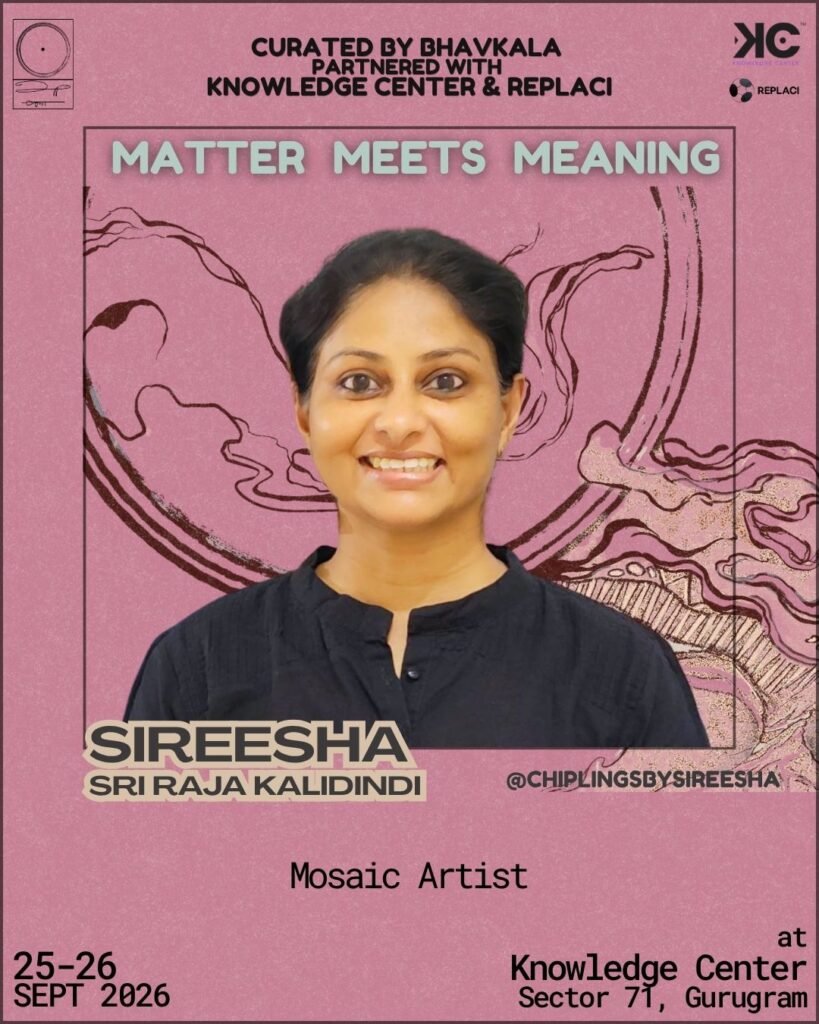
For Sireesha Sri Raja Kalidindi, mosaic is not simply the arrangement of small pieces into a larger image. It is a process of cutting, shaping, observing, and responding to material.
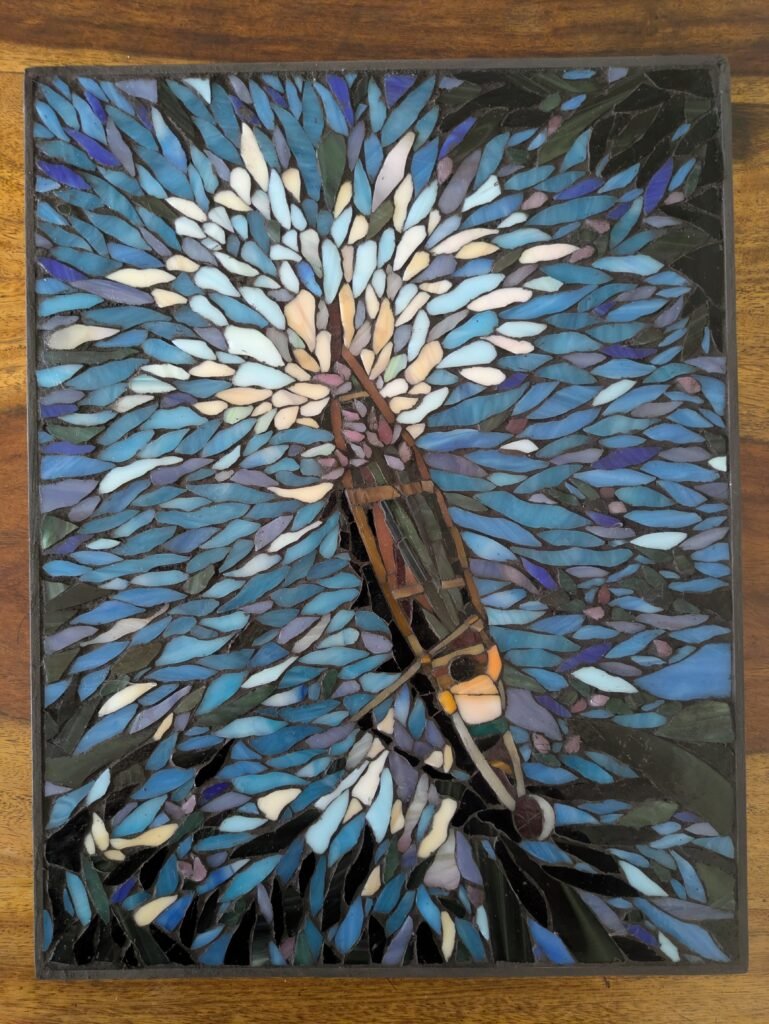
Working predominantly with hand-cut glass, Kalidindi creates contemporary mosaic artworks in which individual pieces function almost like gestures or strokes. Rather than following the rigid uniformity traditionally associated with mosaic techniques, she embraces irregular shapes, varied textures, expressive placement, and the changing relationship between colour and light.
Her artistic journey, however, began far away from the mosaic studio. It moved through engineering, animation, visual effects, product design, handmade paper, handloom materials, and teaching before eventually finding a distinctive language in contemporary mosaic art.
Kalidindi describes her creative inclination as something that was present from an early age.
Her interest was not limited to conventional drawing or painting. She was naturally attracted to craft and creative making, often finding ways to bring creativity into her academic work.
Although she eventually studied engineering, creative exploration remained an important part of her life. During college, she participated in art-related activities and collaborated with architecture students on their projects.
Engineering, therefore, became one part of her educational journey, but it was not the field she ultimately wanted to pursue creatively.
After completing her engineering degree from SRM Engineering College, Chennai, Kalidindi began exploring the creative industries.
Following a period after graduation, she approached a 2D animation studio in Hyderabad with her sketches and asked to learn through practical experience. She eventually worked there for several months, discovering the possibilities of animation and visual effects.
This experience led her to pursue a one-year diploma in visual effects and animation.
Her next step was a role at Rhythm & Hues, a visual-effects company whose post-production work included films such as The Chronicles of Narnia, Life of Pi, and Alvin and the Chipmunks. Kalidindi worked there as a camera tracking artist.
For someone who had dreamed of entering the visual-effects industry, the opportunity was significant. Yet the experience also made her aware of the demanding working hours associated with the industry.
She had another instinct pulling her forward: the desire to build something of her own.
After moving to Mumbai following her marriage, Kalidindi began exploring creative possibilities outside visual effects.
She became involved in different forms of design and material-based work, including product design for a handmade paper company and working with weavers in relation to handloom products.
These experiences exposed her to the tactile and material side of creativity.
Rather than working only through a screen, she increasingly encountered materials directly—paper, textiles, craft processes, surfaces and handmade objects.
This relationship with material would later become an important part of her mosaic practice.
Kalidindi’s contemporary mosaic practice developed through experimentation rather than a single predetermined path.
Over time, she became increasingly interested in the possibilities of texture, colour and material application.
Her approach deliberately moves away from the idea that mosaic must consist of identical pieces arranged in rigid patterns.
Instead, she hand-cuts glass into irregular shapes and treats these fragments as expressive marks.
A piece of glass can function almost like a brushstroke: its size, direction, texture and position contribute to the rhythm of the composition.
This gives each artwork a sense of movement and individuality. Even when she repeats a motif, the arrangement of pieces can naturally change, allowing the process to remain intuitive rather than mechanically reproduced.
Glass is central to Kalidindi’s current visual language.
She works predominantly with opaque art glass, allowing texture and light to interact across the surface of her mosaics.
The relationship between the individual pieces and their surroundings becomes especially visible when natural or artificial light falls across the artwork. Reflections can introduce unexpected shifts in colour and perception.
For Kalidindi, the material therefore continues to participate in the artwork even after it has been cut and placed.
The mosaic is not only about the image represented. It is also about how the surface behaves.
One of the distinctive aspects of Kalidindi’s process is the attention she gives to grout.
Rather than treating grout simply as a practical filler between pieces of glass, she considers it part of the visual composition.
The width and movement of the gaps between pieces can influence the rhythm of the entire artwork. The colour of the grout can also alter the relationship between the glass fragments.
White grout can intensify reflected light, while darker grout can create stronger contrast and visually ground brighter colours.
The completed appearance only becomes fully apparent after the grout has cured and the individual pieces have been cleaned.
As Kalidindi’s confidence with the medium grew, so did the scale of her work.
One of her early large-scale structural experiments was created on an exterior wall at her mother-in-law’s home.
The approximately 11-by-4-foot work featured a large cow motif made from hand-cut ceramic tiles. The project became an opportunity to understand how mosaic behaves when transferred from smaller studio experiments to architectural surfaces and outdoor conditions.
This experience opened the door to larger commissioned projects.
Her practice subsequently expanded into residential, hospitality, public and architectural contexts.
Kalidindi’s work demonstrates how mosaic can move beyond a conventional framed artwork and become part of an architectural environment.
For a bed-and-breakfast in Goa, housed in a restored Portuguese heritage villa, she created a large black, white and grey mosaic influenced by the graphic sketch style of Goan cartoonist Mario Miranda.
Touches of red and blue appear in the figures’ clothing, while sunlight interacting with the glass produces unexpected reflections across the monochromatic composition.
In Visakhapatnam, she created a public mosaic for the Sea Harrier Museum, depicting an aircraft launching from the aircraft carrier INS Viraat.
Another large-scale project in Hyderabad took the form of an 8-by-8-foot garden-themed mosaic, incorporating birds and colourful parrots.
These projects illustrate the flexibility of her practice: the same material language can adapt to walls, gardens, public spaces and private interiors.
Among Kalidindi’s ambitious private commissions was a large glass mosaic created for a collector’s residence in California.
The work consisted of three panels, each approximately 6 by 4 feet, forming a composition featuring Radha Krishna, sacred cows, peacocks and lush greenery.
The completed work was extremely heavy, weighing approximately 160–180 kilograms, making transportation a major part of the project.
Kalidindi worked with a carpenter to create custom packaging strong enough to transport the panels safely. The work was eventually shipped in a container, with delivery costs reaching approximately ₹1.2 lakh.
The logistical challenge became part of the story of the commission itself.
For an artist working largely independently, producing a monumental artwork is only one part of the process. Packing, structural support, transportation and installation can become equally important considerations.
Perhaps the most personal element of Kalidindi’s commissioned practice is her approach to understanding the client.
Rather than beginning with a generic interior moodboard, she asks collectors to share something personal:
What is your story?
She is interested in memories, identities, interests, music and experiences that can become the conceptual foundation of a mosaic.
This approach transforms the commission from a decorative object into something connected to the person who will live with it.
In one commission discussed during the interview, the client’s lifelong passion for a heavy metal band became an important conceptual element in the artwork.
For Kalidindi, the material labour of mosaic makes this emotional connection especially meaningful. Every piece of glass must be individually cut and shaped, making the finished work inherently time-intensive and personal.
Although glass mosaic is now central to Kalidindi’s practice, her creative journey has consistently involved different materials and disciplines.
From handmade paper and handloom materials to animation, visual effects, design and mosaic, her career has been shaped by curiosity about how things are made.
This history helps explain the tactile character of her current work.
Her background in visual effects brought an understanding of images and composition; her design experiences brought her closer to materials; and mosaic provided a space where image, material, texture, light and architecture could exist together.
Kalidindi’s work demonstrates how a traditional material language can be approached through a contemporary sensibility.
Rather than reproducing classical mosaic techniques exactly, she gives herself freedom in the way she cuts, arranges and combines glass.
Irregular fragments become expressive marks.
Grout becomes part of the composition.
Light becomes an active participant.
Architecture becomes a potential canvas.
And the story of the person commissioning the work can become its conceptual starting point.
This combination allows her mosaics to occupy a space between fine art, craft, design and architecture.
Kalidindi continues to explore ways of expanding her studio practice.
The transcript notes plans to incorporate fused glass techniques into her existing mosaic workflow as her studio develops.
This suggests an ongoing interest in pushing the possibilities of glass beyond its current application in hand-cut mosaic.
For an artist whose journey has repeatedly crossed disciplines, experimentation remains an important part of the process.
Sireesha Sri Raja Kalidindi’s artistic journey is a story of transitions.
Engineering led to animation. Animation led to visual effects. Design introduced new relationships with handmade materials. And eventually, these experiences converged in mosaic.
Today, her hand-cut glass works bring together material, texture, colour, light and personal narrative.
Each individual shard is small.
But collectively, these fragments can become monumental images—birds in a garden, figures in a Goan villa, an aircraft in a museum, or Radha Krishna surrounded by peacocks and greenery.
That transformation from fragment to whole sits at the heart of Kalidindi’s practice.
Her mosaics remind us that an artwork does not always emerge from one uninterrupted path. Sometimes it is assembled gradually—experience by experience, material by material, and piece by piece.