Instagram: @Thou_art_shikha
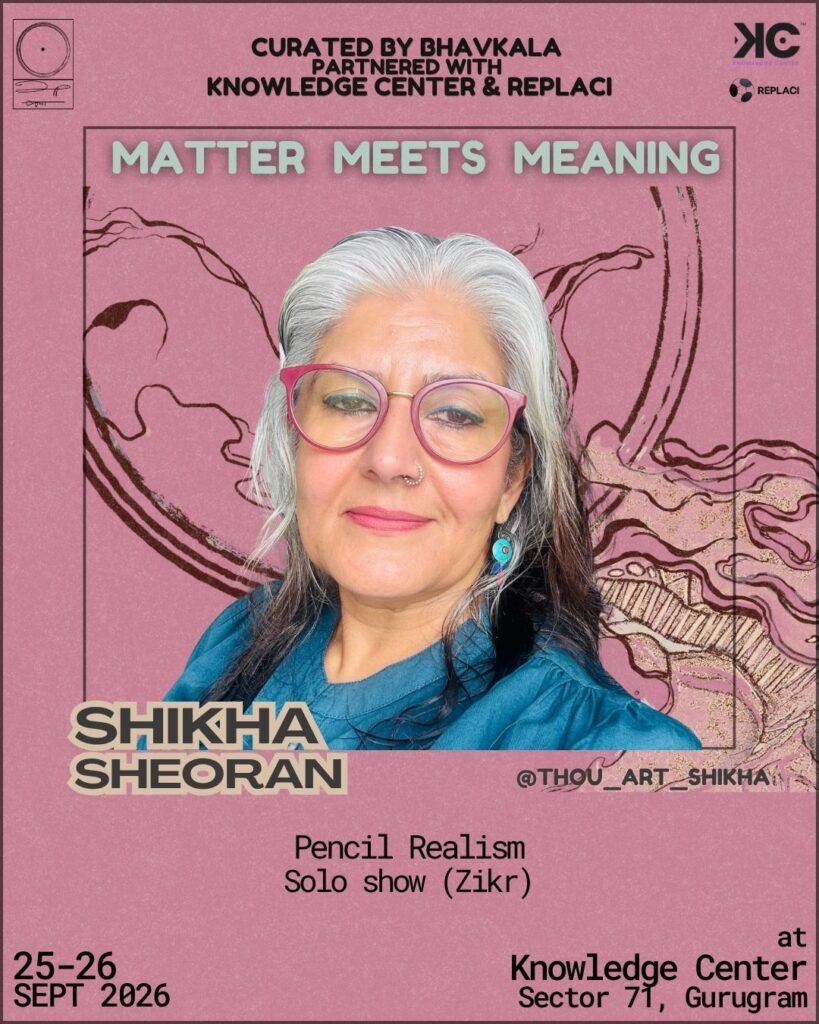
A human face can hold a lifetime of stories—memories, emotions, experiences, and identities that may never be spoken aloud. For artist Shikha Sheoran, observing these stories has become central to her artistic practice.
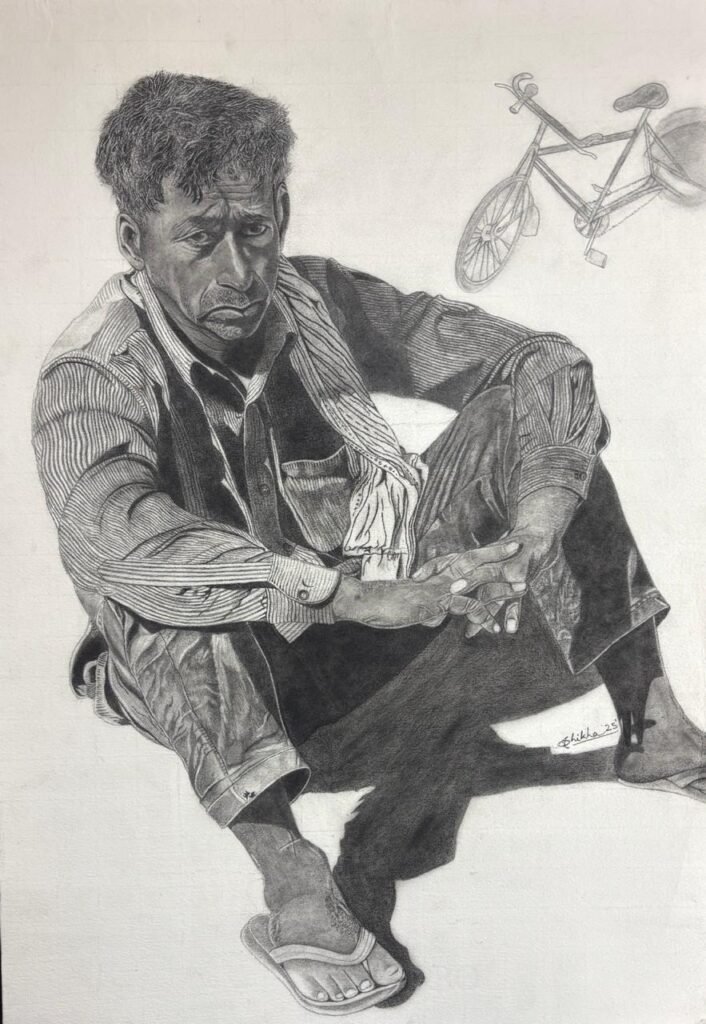
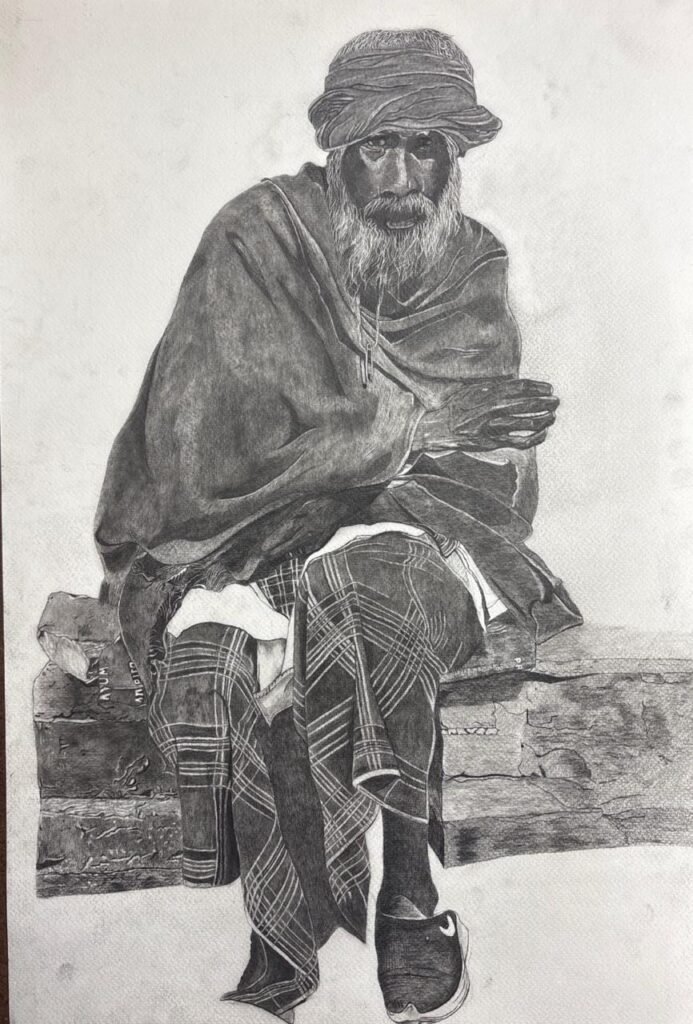
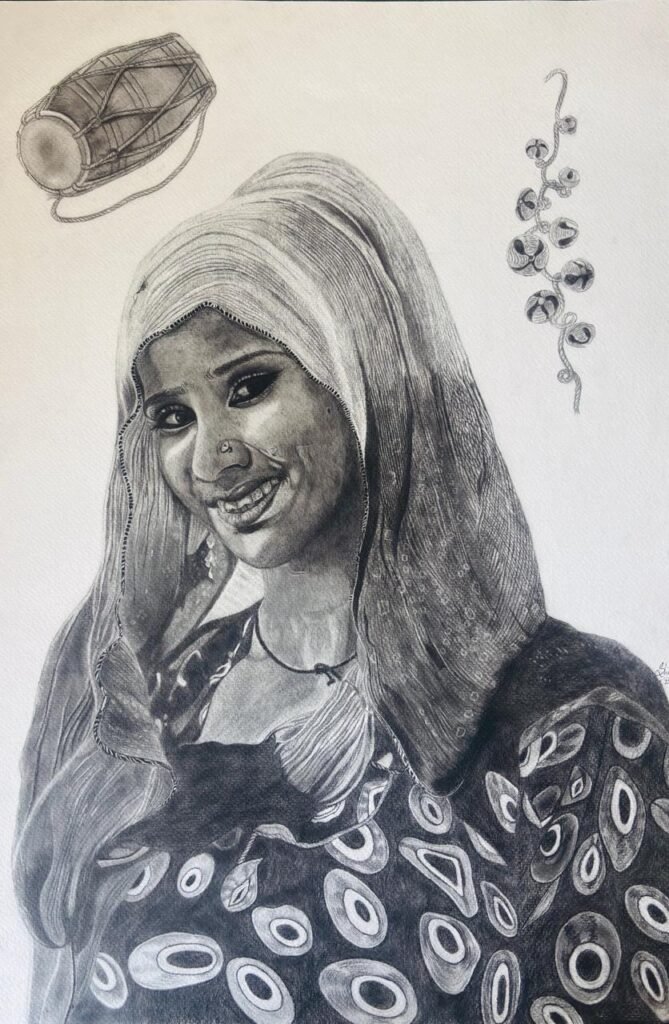
Working primarily with pencil and paper, Sheoran creates realistic portraits that draw attention to people who often remain unnoticed in everyday life. Her practice combines close observation, patience, and an enduring interest in human behaviour, transforming ordinary faces into carefully rendered portraits.
Her journey into art, however, did not begin in a formal art school. It began much earlier—with magazine portraits, biology diagrams, a fascination with faces, and a pencil.
Growing up in Kashipur, Uttarakhand, Shikha Sheoran developed an interest in drawing as a child. She recalls copying portraits from magazines and making cartoons, gradually developing an instinct for studying faces and details.
Her interest in drawing continued when she chose science and studied biology. Her biology diagrams became an unexpected space for artistic exploration. She spent considerable time carefully rendering structures through pencil, shading, and what she now recognises as stippling.
At the time, she did not think of these exercises as an artistic technique. Yet her professors noticed the quality of her drawings. Some of her biological illustrations were even taken from her files, framed, and displayed in their offices.
What began as an academic exercise was quietly developing the precision and patience that would later become fundamental to her portrait practice.
After completing her B.Sc. from RHGPG College, Kashipur, affiliated with Kumaun University, Sheoran worked in the banking sector before marriage.
Art remained a personal interest rather than a profession. During different stages of her life, she experimented with oil and acrylic painting, particularly while creating works for her home. Yet, despite exploring colour and other mediums, she repeatedly returned to pencil.
There was something about graphite that continued to hold her attention.
The pencil offered her the ability to work gradually, build tonal variation, and concentrate on the smallest details. Over time, this preference developed into a distinctive commitment to realistic pencil portraiture.
Sheoran’s artistic development has also been shaped by a life of movement.
Following her marriage to an army officer, she lived in and travelled through different parts of India and abroad, including Punjab, Kashmir, Leh, Chennai, Nashik and Deolali, as well as spending a year in England and three years in Rome.
Among these experiences, Rome left a particularly strong impression on her.
Living there until 2017 gave Sheoran the opportunity to encounter the history and visual culture of Renaissance Italy. She visited Vinci, the birthplace associated with Leonardo da Vinci, and explored places connected with Michelangelo.
For Sheoran, these experiences became more than travel. She describes visiting Italy and encountering its artistic history as something close to a pilgrimage. The experience strengthened her connection with realistic representation and deepened her appreciation for the traditions of figurative art.
A significant moment in Sheoran’s artistic journey came in 2018, when she was living in Leh.
There, she encountered members of the Brokpa community, whom the transcript also refers to as the Red Aryans. She became fascinated by their faces and the stories she imagined behind them.
During walks and everyday interactions, she found herself observing people closely. This developed into a desire to document their faces through portraiture.
The experience marked an important transition—from drawing as a long-standing personal interest toward a more focused engagement with portraiture.
Sheoran’s interest in faces is closely connected to her fascination with human behaviour.
She has always been interested in watching people in everyday situations—whether travelling, sitting at a station, or simply observing people around her. She imagines their circumstances and wonders about the lives behind the faces she encounters.
This interest eventually became an academic pursuit as well. She completed a degree in psychology in 2020, adding another dimension to her understanding of human behaviour.
For Sheoran, a portrait therefore begins before the pencil touches the paper. It begins with looking.
The face becomes a point of entry into questions about identity, emotion, experience, and the stories people carry with them.
Sheoran’s transition into the professional art world was supported by an artist community connected to the Army Wives Welfare Association (AWWA).
After moving to Delhi, she registered as an artist through the platform, which helped connect talented military spouses with opportunities to present their creative work.
In 2022, Sheoran and a group of around twenty women artists came together for a group exhibition at AIFACS in Delhi.
The exhibition gave her an opportunity to place her work in a professional gallery environment and receive feedback from art professionals. The positive response encouraged her to continue exhibiting her work.
She subsequently participated in the AIFACS annual exhibition, where she received a cash award for one of her portraits.
From 2022 onward, Sheoran became increasingly active in Delhi’s exhibition circuit.
Even while living in Ferozepur, Punjab, she travelled back to Delhi regularly to participate in group exhibitions. She estimates that she took part in approximately 20 to 30 group shows during this period.
Her work was exhibited across several Delhi venues and galleries, including Visual Arts Gallery, Lalit Kala Akademi and Stainless Gallery, among others.
For an artist whose practice developed outside conventional art-school training, this sustained exhibition activity became an important part of her professional evolution.
In February 2026, Sheoran presented her first solo exhibition, Zikra, at the Annexe (NX) Gallery of the India International Centre in New Delhi.
The title Zikra—associated with the idea of mention or remembrance—reflects the central thought behind the exhibition.
Sheoran turned her attention towards people who frequently pass through public life without being noticed: street vendors, sanitation workers, domestic workers, and others whose labour forms part of the everyday environment around us.
Instead of treating these individuals simply as background figures, her portraits place their faces at the centre.
The exhibition became an opportunity to pause, look closely, and acknowledge people whose presence can otherwise become invisible through familiarity.
An important conceptual connection runs through Zikra: the relationship between Sheoran’s subjects and her medium.
Sheoran sees the pencil as a humble and foundational artistic tool. Pencil marks often form the underlying structure of paintings created in other mediums, yet once a finished artwork appears, attention tends to shift towards oil, acrylic, or watercolour.
For Zikra, Sheoran brought both elements—the people she portrays and the pencil she uses—into focus.
The subjects are people who may often be overlooked, while the pencil is itself a medium that can be overlooked once the final artwork is complete.
By creating finished realistic portraits using graphite, Sheoran connects these two ideas of quiet visibility.
The pencil is not merely a tool in her work. It becomes part of the conceptual language of the portraits.
Sheoran continues to work primarily within realism.
Her attraction to realistic portraiture is connected to her experiences with classical art, her interest in human behaviour, and her fascination with the visual character of the human face.
For her, realism provides the discipline to remain attentive to details—the texture of skin, expressions, shadows, lines, and subtle changes in a face.
At the same time, she sees her practice as open-ended. She acknowledges that her visual language may evolve in the future, but for now, realistic portraiture remains the space in which she finds the greatest creative engagement.
One of the defining aspects of Sheoran’s journey is that she did not follow a conventional fine-art education.
Her artistic practice developed gradually through observation, experimentation, science diagrams, travel, and an enduring personal relationship with drawing.
What began as a childhood habit eventually became a professional practice.
Her journey demonstrates how an artistic language can develop outside formal structures—through years of looking, making, learning, and returning repeatedly to the same medium.
Today, based in Gurugram, Sheoran is continuing to develop her practice with a focus on realistic pencil portraiture and the human stories that inspire it.
Shikha Sheoran’s portraits begin with a simple act: looking closely.
A face encountered on a street, a worker passing through a neighbourhood, or a stranger observed during travel can become the starting point for a deeper visual inquiry.
Through pencil and paper, Sheoran gives these faces time and attention.
Her practice reminds us that portraiture is not only about reproducing appearance. It can also be about recognising presence.
In bringing overlooked people into focus—and placing pencil, an equally humble medium, at the centre of her practice—Sheoran creates a body of work rooted in realism, observation, and human curiosity.
At Bhavkala, where independent artists and their individual creative journeys are brought into conversation, Shikha Sheoran’s practice offers a compelling example of how a simple medium can carry an expansive story.