People liked the post
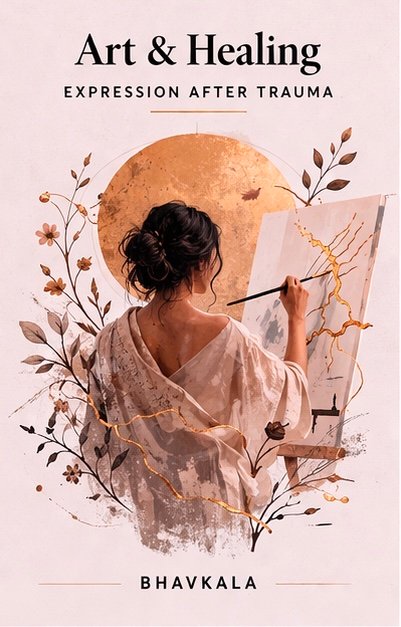
Trauma often exists beyond language.
For many survivors of sexual abuse, experiences are difficult to articulate. Memory, emotion, and the body hold what words cannot. Research in trauma psychology suggests that traumatic experiences are often stored as non-verbal and sensory memory, making expression through words alone challenging.
This is where creative expression becomes important.
Trauma disrupts the natural processing of experience. Instead of being stored as a clear narrative, it remains fragmented and held in the body, emotions, and subconscious patterns.
According to research referenced by The Body Keeps the Score, trauma is not just remembered—it is physically experienced. This is why many survivors struggle to “explain” what they feel, even when they are aware of it.
Expression, therefore, must go beyond language.
Art therapy and creative practices provide a non-verbal pathway to process internal experiences.
Activities such as painting, movement, music, or writing allow individuals to externalize what they may not yet be able to verbalize. According to the World Health Organization, engagement with the arts can:
Similarly, studies from the National Center for Biotechnology Information show that creative expression activates areas of the brain involved in emotion and sensory processing, helping individuals safely engage with traumatic memory.
One of the most significant impacts of trauma is the loss of control.
Creative expression can help restore this.
Research supported by the National Institutes of Health highlights that art-based practices can improve:
Through art, individuals make choices—what to create, how to express, when to stop. These small acts of control become meaningful in the healing process.
It is important to understand that art is not a replacement for therapy or professional care.
However, it can be a powerful starting point.
The process is not about creating something perfect. It is about creating something honest. Over time, this honesty can help rebuild connection—with the self, the body, and the ability to express.
Healing is not linear. There is no single method that works for everyone.
But art offers something unique:
A space where expression can exist without pressure, judgment, or the need for explanation.
Art and healing are deeply connected through the act of expression.
For survivors of trauma, especially sexual abuse, creative practices can provide a safe and accessible way to begin processing internal experiences. While it does not replace structured healing methods, it supports emotional release, awareness, and reconnection.
In many cases, that is where healing begins.